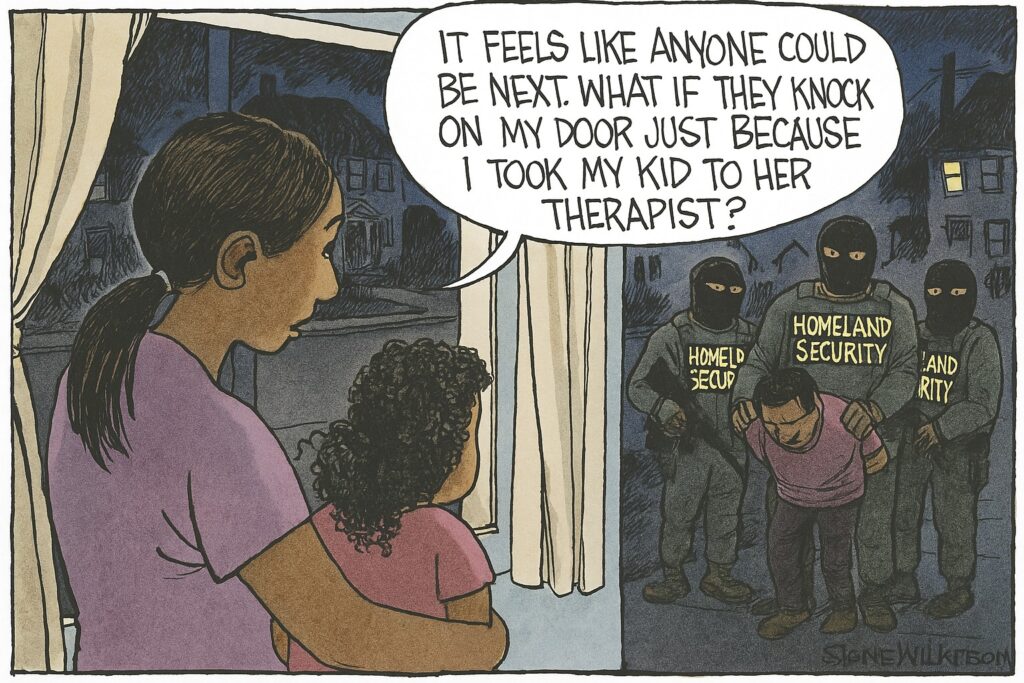
The Trump administration’s latest move has widened the net of immigration enforcement to a scale the country has never seen before. In the last 24 hours, officials confirmed a policy shift that directly impacts an estimated 55 million visa holders already inside the United States. What had once been the territory of border enforcement and visa screening for new arrivals is now being retrofitted into a vast retroactive system aimed at those who have long since cleared the government’s background checks.
The measure rests on two pillars. First, mandatory social media vetting: visa holders, whether they entered on student, work, or family grounds, are now subject to continuous surveillance of online activity. Second, conditional re-review of visa eligibility: categories that were once relatively stable can be reopened, with status revoked based on shifting criteria. In practice, this means a software engineer in California, a graduate student in Michigan, and a truck driver in Texas all face the same uncertainty—compliance that was sufficient yesterday can be judged insufficient tomorrow.
This escalation collapses the line between legal presence and precarious presence. A visa once meant entry into a predictable process; now it is a foothold on a cliff. Families that invested years of work, education, and community ties into life here are discovering that their legal foundation can be pulled out from under them with the stroke of a pen. It is not deportation in the classic sense—it is destabilization, a form of civil insecurity that keeps millions suspended in uncertainty.
The economic contradictions are just as sharp. Entire industries—from agriculture to logistics to research labs—depend on visa holders. By treating them as perpetually suspect, the administration risks hollowing out labor pipelines while claiming to defend the American worker. It is a policy that uses fear as leverage, one that treats social participation as a privilege to be revoked rather than a contribution to be respected.
The deeper point is about precedent. When a government normalizes turning back to re-examine the status of those who already complied with the law, it signals that no line is ever firm. Temporary presence becomes probationary presence. Compliance is never final. For immigrant families, the message is not just about paperwork. It is about permanence—whether this country is willing to allow it, or whether permanence itself is being erased.