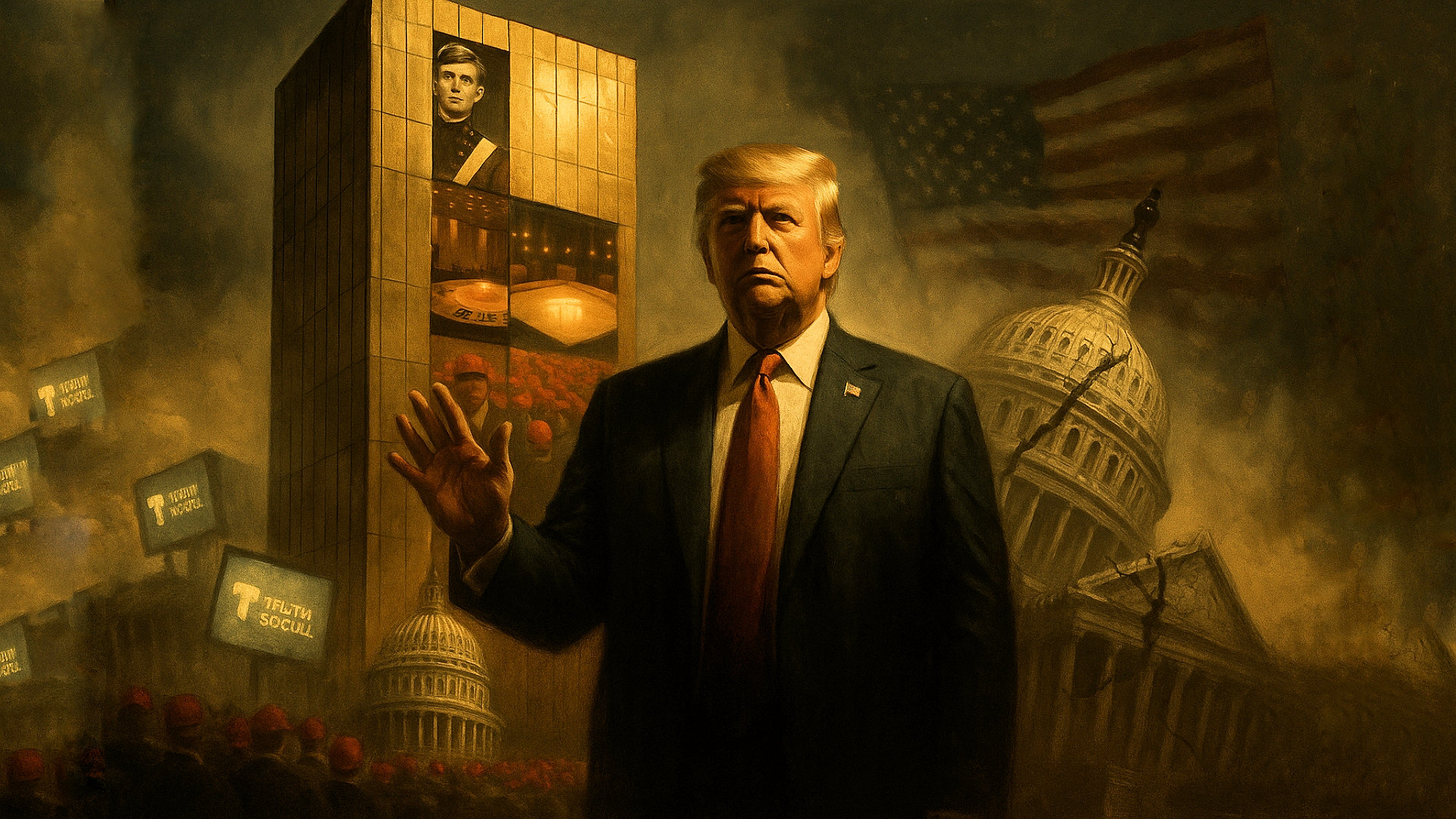
 Donald Trump’s rise to political power did not emerge suddenly in 2016, nor was it an aberration without precedent. His trajectory can be traced across decades — from his youth in Queens, to the Manhattan skyline, to Atlantic City casinos, to reality television stardom, and finally to the Oval Office. At every stage, the same instincts that marked his personality — dominance, spectacle, grievance, and the relentless pursuit of winning — found new arenas of expression.
What emerges from this history is not simply the story of a businessman turned president, but of a man who honed an authoritarian style long before entering politics. Trump learned early that power could be achieved through performance, intimidation, and control of narrative. He mastered institutions by bending them to his will, and when guardrails resisted, he treated them as obstacles to be dismantled. His life provides a study in how celebrity, wealth, and grievance politics can be fused into a personal ideology of rule — one that ultimately reshaped American democracy itself.
Each of the following explores a period of Trump’s progression.
Donald Trump’s Childhood Through Military School—Donald Trump grew up in a wealthy but strict Queens household, shaped by his domineering father, Fred Trump. Labeled unruly and difficult, he was sent at age 13 to the New York Military Academy. Instead of curbing his behavior, the regimented environment sharpened his appetite for status, competition, and control. Excelling in sports and cultivating authority, Trump learned how institutions reward dominance and image management—traits that would define his ambitions and later public persona.
The Narcissist in a Suit (1964–1968)—Donald Trump exited military school with a mastery of style and hierarchy, enrolling at Fordham before transferring to Wharton—where prestige mattered more than ideas. Weekend visits to New York introduced him to his father’s real-estate network. Amid 1960s campus turmoil, he remained unfazed—steering clear of activism, prioritizing deals over idealism. With a transactional mindset honed, he graduated poised to redefine the family business through spectacle and strategic leverage.
Donald Trump’s Authoritarian Formation (1968–1982)—Between 1968 and 1982, Donald Trump transformed from heir to operator, pushing beyond his father’s cautious empire into Manhattan’s high-stakes stage. The Grand Hyatt deal epitomized his formula: distressed assets, political leverage, and aggressive branding. Roy Cohn sharpened his instincts for intimidation and transactional power. With Trump Tower rising, “Trump” became less a name than a brand—synonymous with luxury, audacity, and winning. By 1982, he had fused profit, politics, and spectacle into a personal ideology of dominance.
Casino Capitalism and the Cult of Winning (1983–1999)—Between 1983 and 1999, Donald Trump built an empire defined by spectacle and leverage. Trump Tower crowned his arrival in Manhattan, while Atlantic City casinos — culminating in the Taj Mahal — showcased his appetite for risk. Junk bonds fueled expansion but also crisis, forcing high-stakes survival negotiations in the early ’90s. Reinvention through media spectacle, licensing, and modest comebacks kept the Trump brand alive. By decade’s end, perception itself became his most profitable asset.
The Apprentice Years: TV, Tabloids, and the Cult of Personality—From 2004 onward, The Apprentice recast Donald Trump as a commanding business icon, projecting wealth and decisiveness to millions. The show doubled as a brand commercial, amplifying his name across skyscrapers, pageants, and licensing deals worldwide. Tabloid saturation blurred business, celebrity, and spectacle, while Twitter added unfiltered provocation. By 2011, his embrace of the “birther” conspiracy showcased how political theater could serve like reality TV. This fusion of performance and power prepared the stage for his presidential bid.
Populist by Design, Demagogue by Nature (2015–2016)—Trump’s 2016 campaign fused spectacle, grievance, and branding into a populist insurgency. Announcing in Trump Tower with incendiary rhetoric, he dominated a crowded Republican primary through insult-driven debates, mass rallies, and saturation media coverage. “Make America Great Again” channeled discontent over immigration, trade, and elites. Against Hillary Clinton, he weaponized “Crooked Hillary,” social media provocation, and Rust Belt outreach. Narrow wins in Pennsylvania, Wisconsin, and Michigan secured an Electoral College victory, shocking the establishment and reshaping American politics.
Executive Power Unbound—Trump’s presidency tested the limits of executive power from day one. His early orders — travel bans, deregulation, and aggressive immigration enforcement — reflected disruption over consensus. Legislative losses, like the failed ACA repeal, were offset by tax cuts and record judicial appointments. The Ukraine scandal brought impeachment, but Senate acquittal emboldened him. COVID-19 and nationwide protests defined 2020, sharpening divisions. Refusing to concede after losing to Joe Biden, Trump ended his first term by contesting the system itself.
The Counter-State Campaign (2021–2024) – From the Big Lie to the Final Battle—After losing the 2020 election, Trump waged a counter-state campaign: rejecting results, fueling the “Big Lie,” and inspiring the January 6 assault on the Capitol. Twice impeached, he nonetheless built a parallel power structure from Mar-a-Lago — commanding loyalty through endorsements, PAC fundraising, and election-law battles. Banned from mainstream platforms, he launched Truth Social to sustain his voice. By 2024, his movement fused grievance and retribution into a “final battle” campaign to restore him to power.
The Authoritarian in Power, Unmasked—Donald Trump’s second ascendancy marked a full embrace of authoritarian governance. No longer constrained by guardrails, he centralized power through loyalty tests, politicized the Justice Department, and reshaped the Republican Party into an extension of his brand. His rallies became loyalty rituals, his media platforms propaganda machines, and his judiciary a bulwark for expansive executive authority. To supporters, he reclaimed sovereignty; to critics, he corroded democracy. His legacy: a presidency transformed into a personalized instrument of power.