 Stephen King’s opinions have been getting a lot of traction on social media.
 J.D. Vance is a name that, depending on who you ask, evokes either admiration or disdain. Born into Appalachian poverty, he clawed his way out, penning the bestselling memoir Hillbilly Elegy that catapulted him to literary fame and political relevance. But the story of J.D. Vance is not just one of grit and determination—it’s also one of reinvention and calculation. How did a man who once compared Donald Trump to Hitler end up as Trump’s vice president? And what does that say about him?
The Rise
Growing up in Middletown, Ohio, Vance was no stranger to hardship. Raised primarily by his grandparents in a working-class town, he experienced firsthand the struggles of addiction, poverty, and instability. His memoir, Hillbilly Elegy, put a face to those struggles, capturing the plight of the white working class and turning him into a voice for what he called “the forgotten Americans.” Vance’s military service, followed by his academic achievements at Ohio State and Yale Law School, became a testament to the idea of the American Dream. He was the kid who made it out.
But getting out was only the beginning. Vance leveraged his newfound fame into a venture capital career in Silicon Valley, rubbing elbows with the likes of Peter Thiel. To some, it was the logical next step for a man who understood hardship and wanted to make a difference. To others, it reeked of opportunism—a man leaving behind the very people he claimed to represent. [continue reading…]
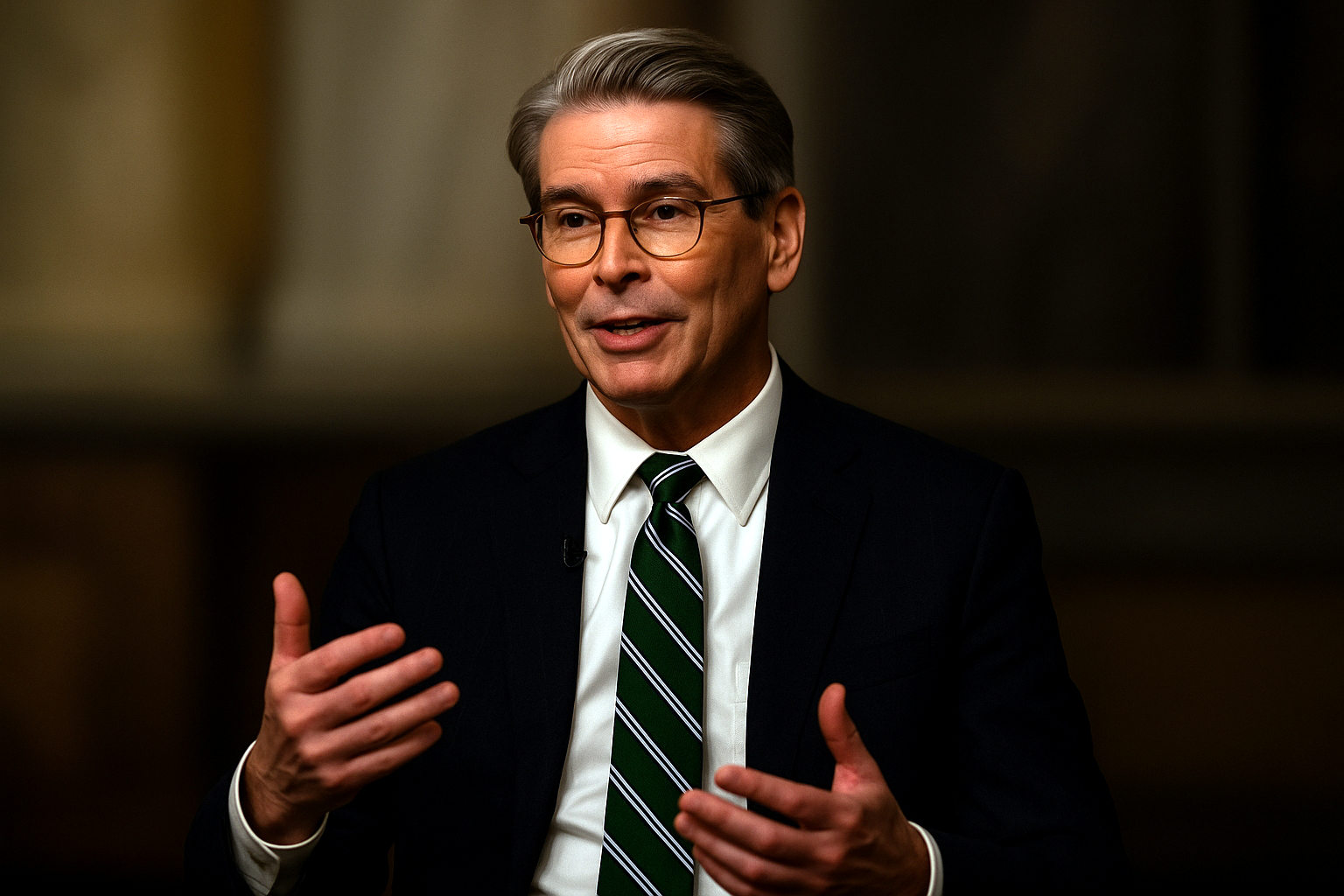 Scott Bessent didn’t exactly stumble into the role of Treasury Secretary. His path was paved with strategic bets and well-placed donations. He’s the kind of guy who knows where to put the money before anyone else even knows there’s a game on. When Trump came calling, it wasn’t because Bessent shared his ideology—it was because he shared his instinct for playing fast and loose with the rules when it suits the agenda.
Born in Conway, South Carolina, Bessent grew up in a world where economic stability was a distant luxury. His father’s bankruptcy and his mother’s turbulent personal life—marked by five marriages, including two to Bessent’s father—should have been obstacles. For him, they were sparks. Barbara McLeod Bessent had taken over the family’s real estate business when Homer Bessent fell ill, an unusual move for a woman in that era. But financial mismanagement led to bankruptcy and the slow dismantling of their holdings. Bessent has recalled watching furniture being hauled out of their home—property that had been in the family for generations. That kind of loss carves its lessons deep, and Bessent seems to have learned them well. [continue reading…]
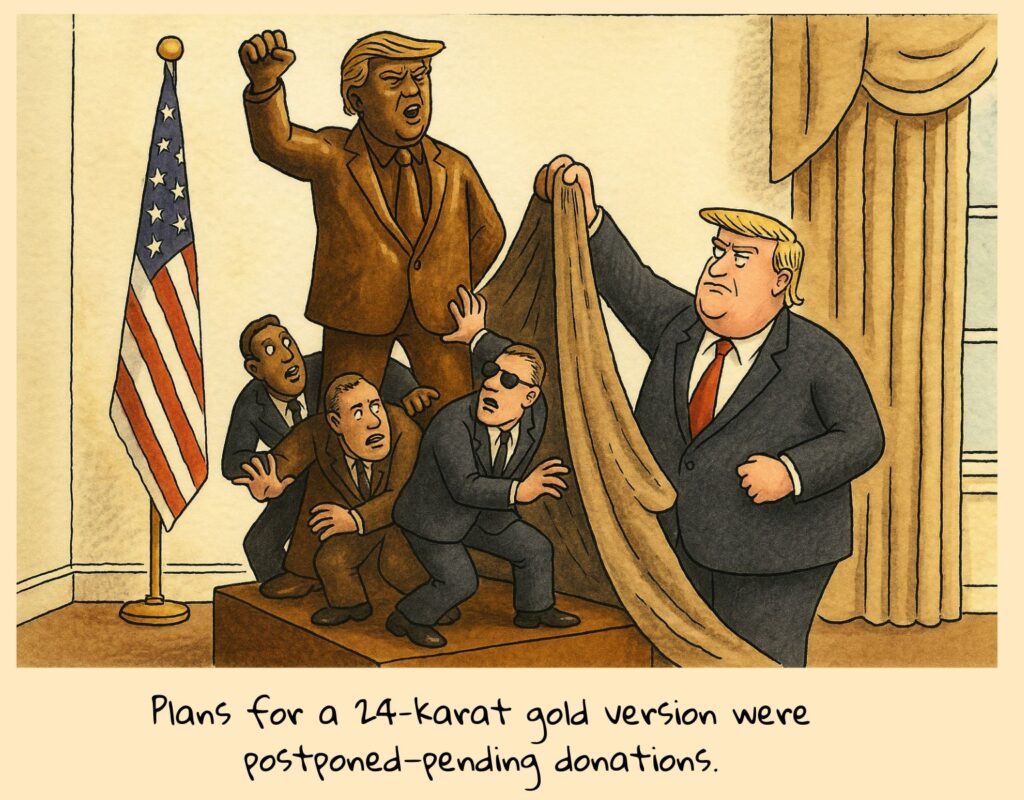
President Trump has added a 12-inch statue to the Oval Office depicting the moment following the July 2024 assassination attempt in Butler, Pennsylvania. The sculpture captures Trump raising his fist defiantly, accompanied by three Secret Service agents and a vertically hanging American flag.
Artist Stan Watts plans to create a larger 9-foot bronze version through the Trump Statue Project, symbolizing resilience and divine intervention.
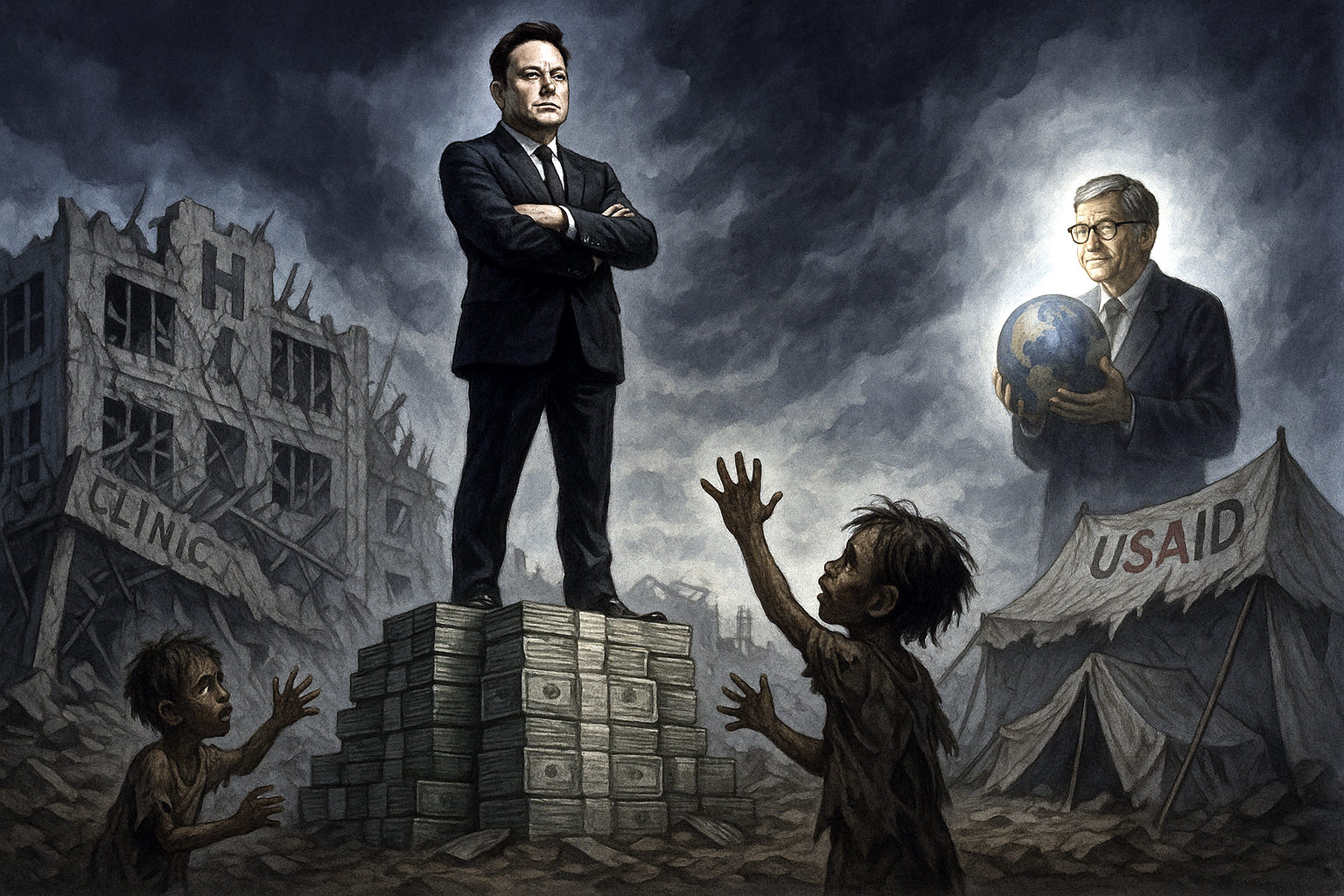 If there was ever a moment that laid bare the hollowness of billionaire benevolence, it happened in May 2025. Bill Gates, co-founder of Microsoft and a self-styled savior of the world’s most vulnerable, came out swinging against Elon Musk in a blistering interview with the Financial Times. Gates accused Musk—the world’s richest man—of having blood on his hands, claiming that Musk’s influence over USAID cuts is, quite literally, killing the world’s poorest children.
Gates didn’t mince words. “The picture of the world’s richest man killing the world’s poorest children is not a pretty one.” It was a stark statement, the kind that strips away the polished veneer of wealth and philanthropy and reveals the raw, rotting core beneath. For Gates, it was more than just rhetoric; it was a call to confront what he sees as the moral bankruptcy of Musk’s so-called ‘efficiency’ initiatives.
DOGE: Efficiency or Evisceration?
Musk’s Department of Government Efficiency (DOGE)—because what better name for slashing aid programs than after a meme?—was championed as a revolution in government spending. In reality, it’s been more of a sledgehammer than a scalpel, hacking away at programs designed to keep the world’s most vulnerable alive. Mozambique’s HIV prevention programs? Slashed. Vaccination campaigns in Africa? Gutted. All under the guise of ‘cutting bloat’ and ‘eliminating waste.’
 Robert F. Kennedy Jr. is a man shackled by legacy, yet seemingly liberated by delusion. A name that once stood for progress now clings desperately to conspiracy, each syllable dragged through the mud of anti-science rhetoric and snake-oil evangelism. RFK Jr. isn’t just a shadow of his forebears—he’s a flickering sideshow, lit briefly by scandal and extinguished by common sense.
Born into a dynasty that practically minted American liberalism, RFK Jr. grew up in the gilded corridors of Hyannis Port and Hickory Hill. Camelot was his playground, a kingdom of high ideals and public service. You’d think that kind of pedigree would inspire a lifetime of integrity. Instead, we’re watching him shuffle around the Department of Health and Human Services like a kid who snuck into his father’s liquor cabinet and then drove the car off a cliff. [continue reading…]
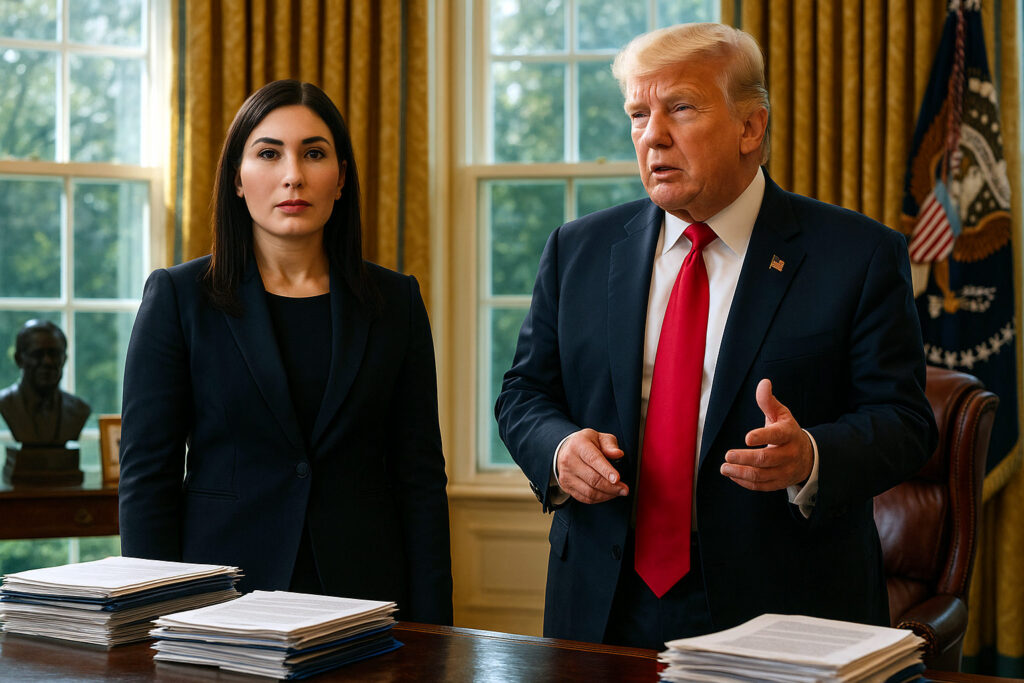 It’s May 2025, and Laura Loomer has gone from being a provocateur on the political margins to a force shaping the inner workings of the Trump administration. Once dismissed as a fringe figure, Loomer now holds significant sway over personnel decisions and policy directions at the highest levels of government.
From Activist to Influencer-in-Chief
Loomer’s journey began with attention-grabbing stunts and controversial statements. However, her unwavering support for Donald Trump and her aggressive promotion of loyalty within his ranks have elevated her status. Her influence became particularly evident in April 2025, when she presented President Trump with opposition research targeting several National Security Council staffers. Shortly thereafter, six officials were dismissed, including NSA Director Gen. Timothy Haugh and his deputy Wendy Noble. While Trump downplayed Loomer’s role, he acknowledged considering her input .
Shaping Health Policy
Loomer’s impact extends beyond national security. In May 2025, she publicly criticized Surgeon General nominee Dr. Janette Nesheiwat for alleged misrepresentations of her medical credentials and her pro-vaccine stance. Following Loomer’s campaign, Trump withdrew Nesheiwat’s nomination and instead selected Dr. Casey Means, a wellness influencer aligned with Health Secretary Robert F. Kennedy Jr.’s “Make America Healthy Again” initiative. Loomer, however, continued her attacks, accusing Means of promoting “Marxist” ideologies .
A Polarizing Presence
Loomer’s ascent has caused friction within conservative circles. Figures like Rep. Marjorie Taylor Greene have expressed concerns about her influence, warning that her rhetoric and actions could be detrimental to the movement’s image. Despite this, Trump has defended Loomer, referring to her as a “free spirit” and valuing her loyalty .
The Implications
Loomer’s rise underscores a shift in the dynamics of political power, where media-savvy activists can leverage their platforms to influence governance directly. Her trajectory from outsider to insider reflects the evolving nature of political influence in the digital age.
As we observe these developments, it’s essential to consider the broader implications for democratic institutions and the balance of power within the government. Loomer’s story is a testament to how unconventional paths can lead to significant influence in today’s political landscape.
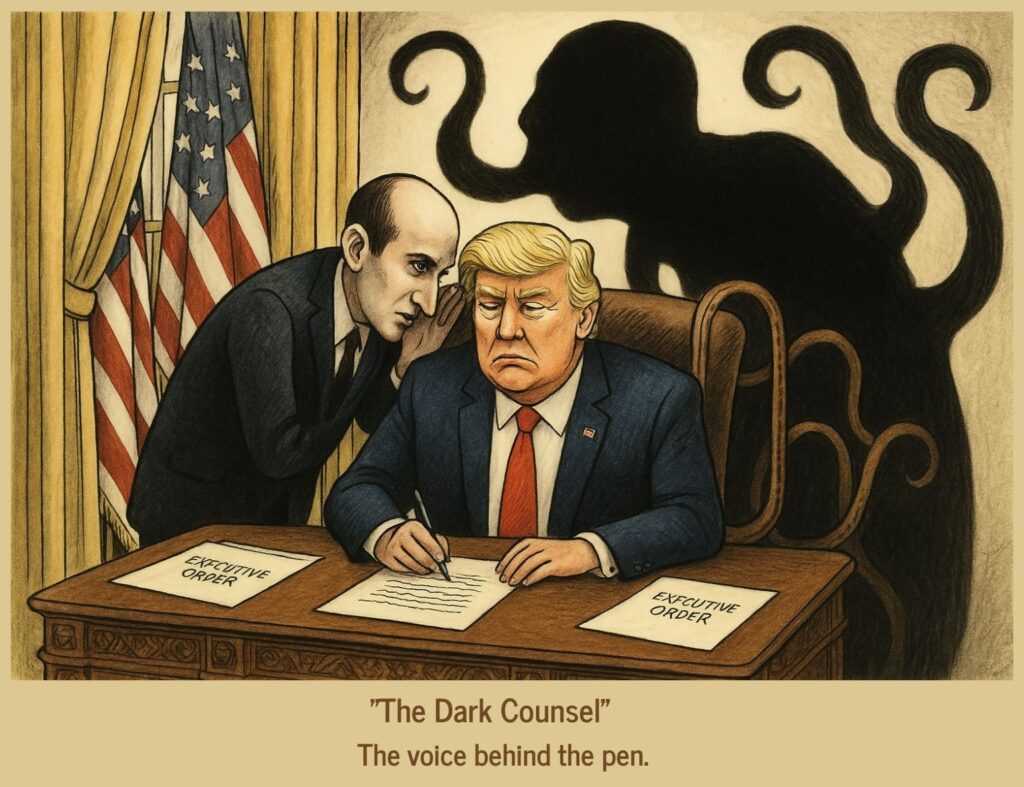 The Dark Counsel encapsulates the eerie influence of shadow advisors on executive power. Stephen Miller, whispering into Trump’s ear, symbolizes more than mere policy suggestion—it’s the unseen grip of ideology, bending the pen that signs executive orders. Looming behind them, the octopus-like shadow hints at something more sinister—tentacles stretching far beyond the room, pulling strings with unseen hands. The caption, “The voice behind the pen,” speaks to the unsettling notion that decisions made in the Oval Office might not be entirely those of the elected leader, but rather steered by the unseen hand of manipulation.

Ras Baraka’s Detention: Politics, Protest, and ICE
A Show of Defiance, A Clash with Authority
On May 9, 2025, Newark Mayor Ras J. Baraka found himself in handcuffs outside the newly reopened Delaney Hall ICE detention facility. It’s not every day you see a mayor hauled off in a federal van like some low-rent bootlegger from the Prohibition era, but here we are. Politics in America has always been a strange beast, but these days it’s positively feral.
Background: Newark as a Sanctuary City
Since 2017, Newark has been recognized as a sanctuary city under Mayor Baraka’s administration. Baraka’s policies are like a stubborn mule—unyielding and unmovable when it comes to U.S. Immigration and Customs Enforcement (ICE) operations within city limits. His public condemnations of federal raids have been as regular as clockwork, each one louder than the last. Baraka’s Newark has no love for ICE, and the feeling is surely mutual.
The Delaney Hall Controversy
In February 2025, ICE announced it would reopen Delaney Hall as a 1,000-bed immigration detention center. Predictably, Baraka bristled at the idea, calling it a federal overreach that was as welcome as a tax audit. To make matters worse, ICE pushed the whole thing through without the necessary city permits. Baraka and three Democratic Representatives—Bonnie Watson Coleman, Robert Menendez Jr., and LaMonica McIver—showed up for an “oversight visit.” What happened next was something straight out of a political noir: federal agents in tactical gear, shoving around elected officials like they’d stumbled onto a crime scene. In a flash, Baraka was cuffed, loaded into an unmarked van, and whisked away like he was about to be ‘disappeared.’
Detention and Release
The political machine roared to life almost immediately. Governor Phil Murphy, U.S. Senator Cory Booker, and New Jersey Attorney General Matthew Platkin fell over themselves condemning the arrest. By late evening, a federal judge ordered Baraka’s release, and just like that, he was back in Newark, hailed as a conquering hero. No charges. Just a political mugging and a quick release. The Department of Homeland Security insisted that Baraka had trespassed and ignored warnings, but the lack of charges told its own story.
Political Implications
Baraka’s brief stint in federal cuffs wasn’t just about him. It was about the long-simmering tension between federal enforcement and sanctuary cities—a battle that’s playing out like a soap opera with real consequences. For his supporters, Baraka is a street-level hero, fighting the good fight against federal overreach. For his critics, he’s a grandstanding showboat, turning a political disagreement into a headline-grabbing spectacle.
No matter how you cut it, the sight of a mayor in handcuffs outside an ICE detention center is as surreal as it is symbolic. In America 2025, it seems the lines between protest and crime, law and spectacle, are just getting blurrier.
Welcome to the Dispatches
Truth matters.
a nine-part, long-form series tracing Trump’s rise, networks, and abuses of power, showing how his trajectory led toward authoritarian rule.