The Weight of Cotton, Revisited

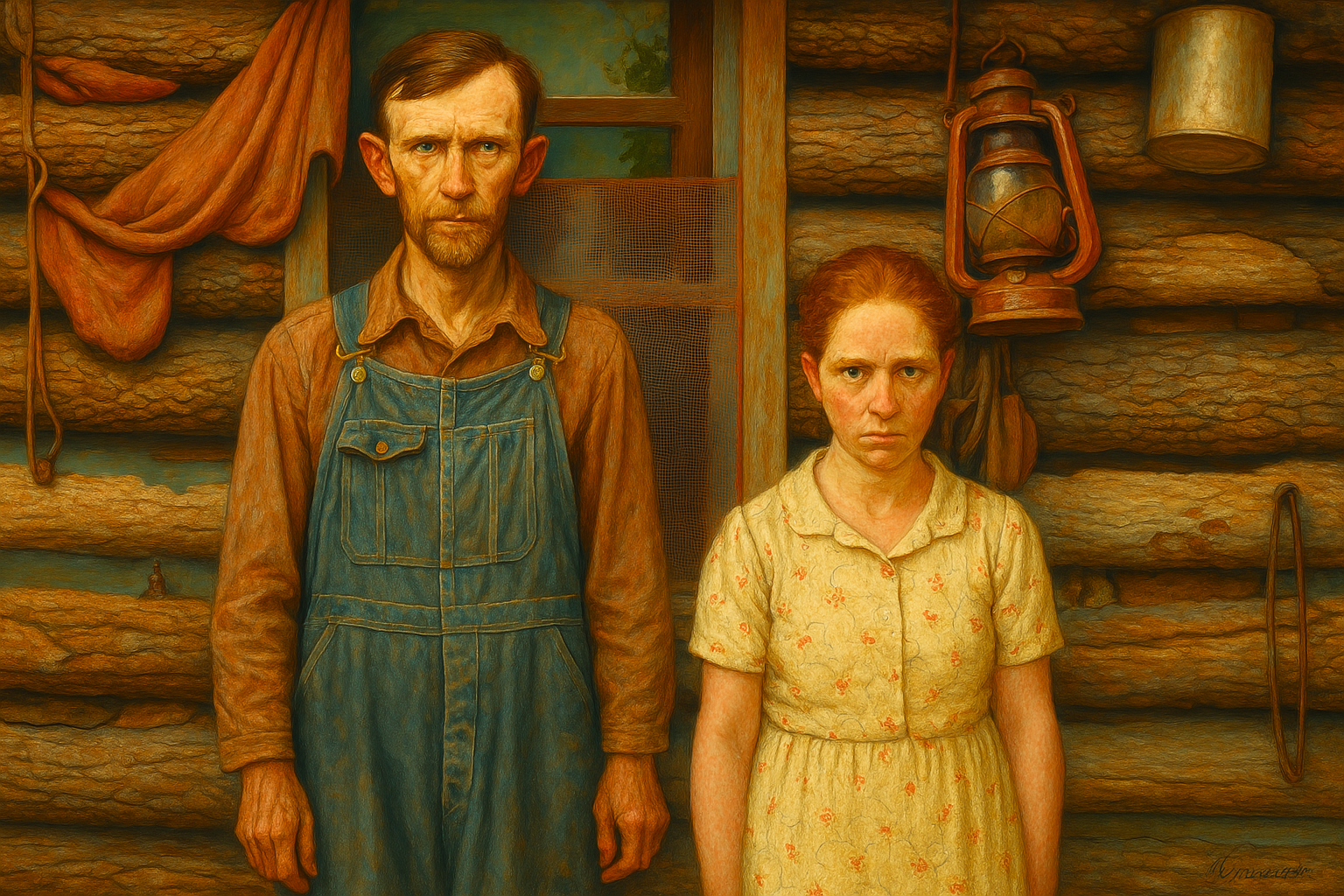
They stare out from the past, unsmiling and unbowed. A man in worn denim overalls and a woman in a faded floral dress, standing shoulder to shoulder in front of a log wall patched with the tools and tokens of survival—lantern, rope, bucket, cloth. They aren’t asking for anything. They’re just letting you look.

This image reimagines Ben Shahn’s 1935 photograph of “rehabilitation clients” from Boone County, Arkansas—tenant farmers living through the worst of the Great Depression. It’s rendered in the style of Norman Rockwell, not to sweeten the hardship, but to make sure we don’t look away from it.

It would’ve been easy to lose the soul in that translation—to let soft brushstrokes blur the sharp truth of poverty. But this version doesn’t blink. The lines etched into the man’s face, the pale strain in the woman’s eyes, the plain clothes, the set of their shoulders—it all still reads clear as a cotton ledger. There’s no sentimentality here, no cozy idealism. Just the hard dignity of people who worked a patch of earth that barely worked back.

I know people like this. You probably do too. Maybe they’re your grandparents, maybe they’re neighbors. Maybe they’re you. There’s something familiar in the way these two stand—defiant not in posture, but in the simple fact that they are still standing.

The original photo came from the Resettlement Administration, part of the federal government’s attempt to hold rural America together during a time of collapse. The people in it were labeled “rehabilitation clients”—a bureaucratic term for those still trying to make something grow after the economy left them for dead. Sounds familiar, doesn’t it?

Tenant farming never really ended. It just changed names. Today it’s contract labor, sharecropping by another word, or debt service disguised as opportunity. And the same weary eyes are still out there—only now they’re scanning gas pumps, hospital bills, or the fine print on a farm loan.

So when someone tells us they want to “Make America Great Again,” it’s worth asking: Is this the “Again?” Is this what they want us to return to—barefoot dignity, back-breaking work, and a government that watches you toil and calls it a success story?

What makes this image powerful isn’t just its style. It’s that it tells a story rarely painted: the unflinching truth of working-class hardship, without the wink. It gives color to a history that’s often remembered in grayscale, and in doing so, insists we look again.

Because sometimes, in order to see how heavy the weight of cotton really was—and still is—you’ve got to bring the past into full color.


Based on the October 1935 photograph by Ben Shahn for the United States Resettlement Administration, this modern reinterpretation captures the same unflinching realism—now reimagined in painterly tones. A man and woman stand before their log home, unsmiling and unmoved, their posture as stark as the times. The original subjects were labeled simply as “rehabilitation clients,” a bureaucratic phrase that barely contains the grit and gravity of their presence.

Their clothes are worn but not ragged. Their eyes do not plead. There is no shame here, only the honesty of rural poverty—and the dignity that endures when everything else is spare.

Adapted from the original FSA/OWI file LC-USF33-006034-M2. Photograph by Ben Shahn, Boone County, Arkansas, October 1935.

AI-generated reinterpretation in the style of Norman Rockwell, drawn from public domain archival reference.

Library of Congress Source


The Past, Reimagined Like Rockwell #9
Is this the “Again?” #3
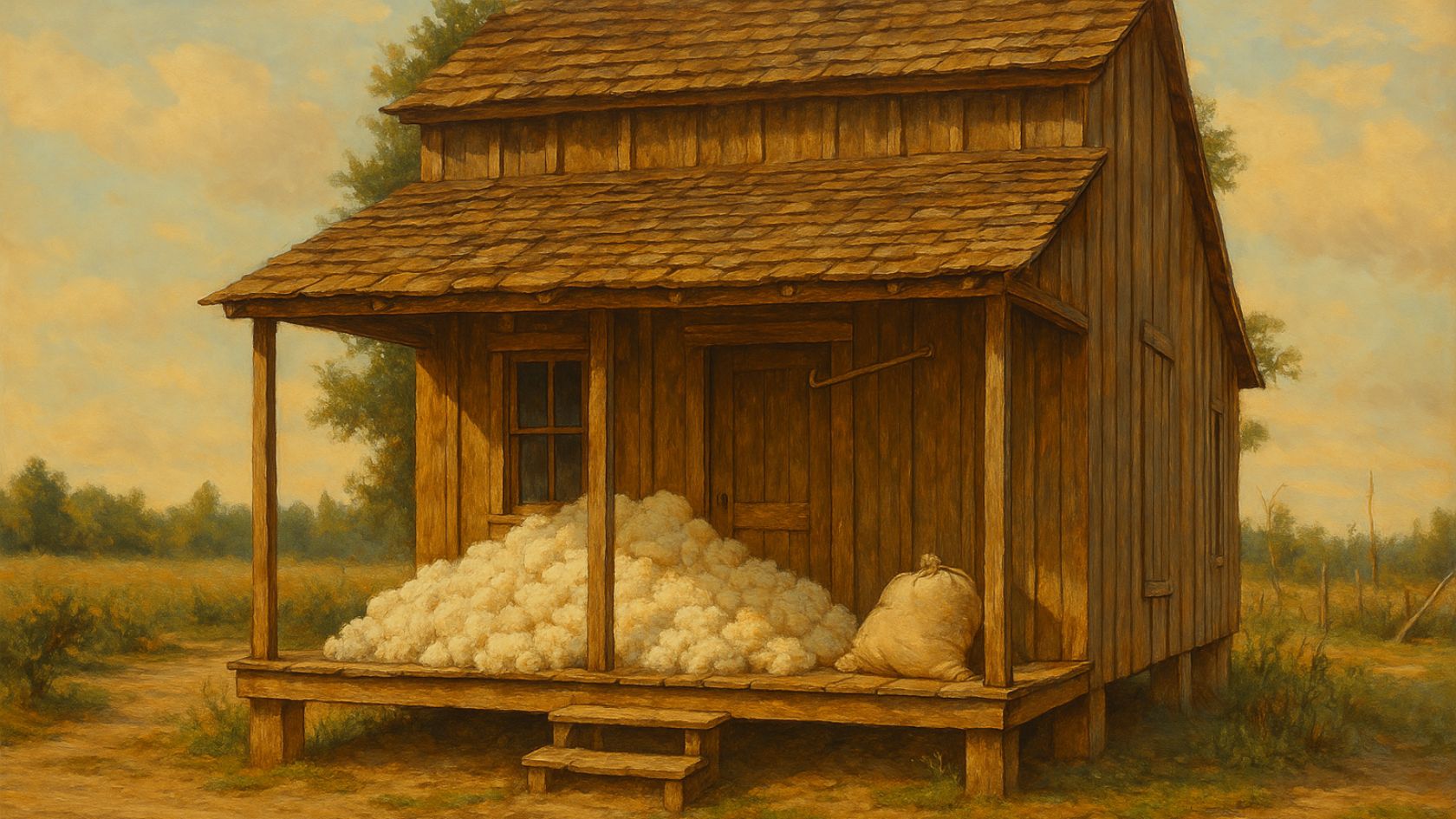
The Weight of Cotton

A simple tenant house. A neat porch stacked high with raw cotton. The image is reimagined from a 1935 photograph taken on the grounds of Maria Plantation in Arkansas. Quiet as it appears, this scene reflects a system that was anything but gentle.

This wasn’t the plantation house. It was one of the many structures where tenant farmers lived and worked—on land they didn’t own, growing cotton they couldn’t profit from. The labor was grueling. The compensation insultingly low. At times, workers earned as little as five cents an hour, barely enough to feed a family, let alone rise out of debt.

Captured by Farm Security Administration photographer Ben Shahn, the original images were part of a national effort to document rural poverty during the Great Depression. They reveal lives shaped by exploitation, not accident. Cotton on the porch wasn’t just a crop—it was a symbol of who held power, and who bore its cost.

Maria Plantation sat somewhere in Arkansas, in the Mississippi Delta region, where cotton dictated the economy and the lives within it. Tenant farmers, often Black and impoverished, had little choice but to endure a cycle of dependence. Even when mechanization arrived and changed the nature of agriculture, the same families were cast aside—without protection, acknowledgment, or land of their own.

The echoes of that era still linger. Rural communities today face different tools, but the same machinery: land consolidation, vanishing autonomy, and systems designed to prioritize profit over people.

The image may look calm, even nostalgic. But there’s a weight in that cotton, and a truth that shouldn’t be softened. What stood on that porch was the product of lives laboring under quiet coercion—structured, sanctioned, and sustained by policy and power.


Do tenant farms still exist?

Here’s the current reality, plain and direct:

  • Rented farmland is widespread: As of the most recent USDA data, about 40% of U.S. farmland is rented, and much of it is worked by people who do not own the land. These farmers range from full-scale operators leasing thousands of acres to small family farmers barely breaking even.
  • Land concentration is accelerating: Ownership is increasingly in the hands of corporations, absentee landlords, and investment groups. Many rural families who once owned land now lease it back just to stay afloat.
  • The economic leverage is the same: Like in the sharecropping era, tenant farmers today often face tight margins, heavy debt, and little control over prices, terms, or weather-related risks. They provide the labor and bear the risk, but profits usually flow upward.
  • No feudal cabins, but the hierarchy remains: Today’s tenant might drive a modern tractor instead of a mule, but the power imbalance hasn’t gone anywhere. It’s just been digitized, financed, and wrapped in legal contracts.

So yes—tenant farming persists. It’s not romantic, and it’s not gone. It’s simply evolved into a more bureaucratic and corporate-friendly form of the same old imbalance.


The Past, Reimagined Like Rockwell #8
Is this the “Again?” #2

They didn’t need a reason. They had a uniform, a badge, and a policy book written in disappearing ink.

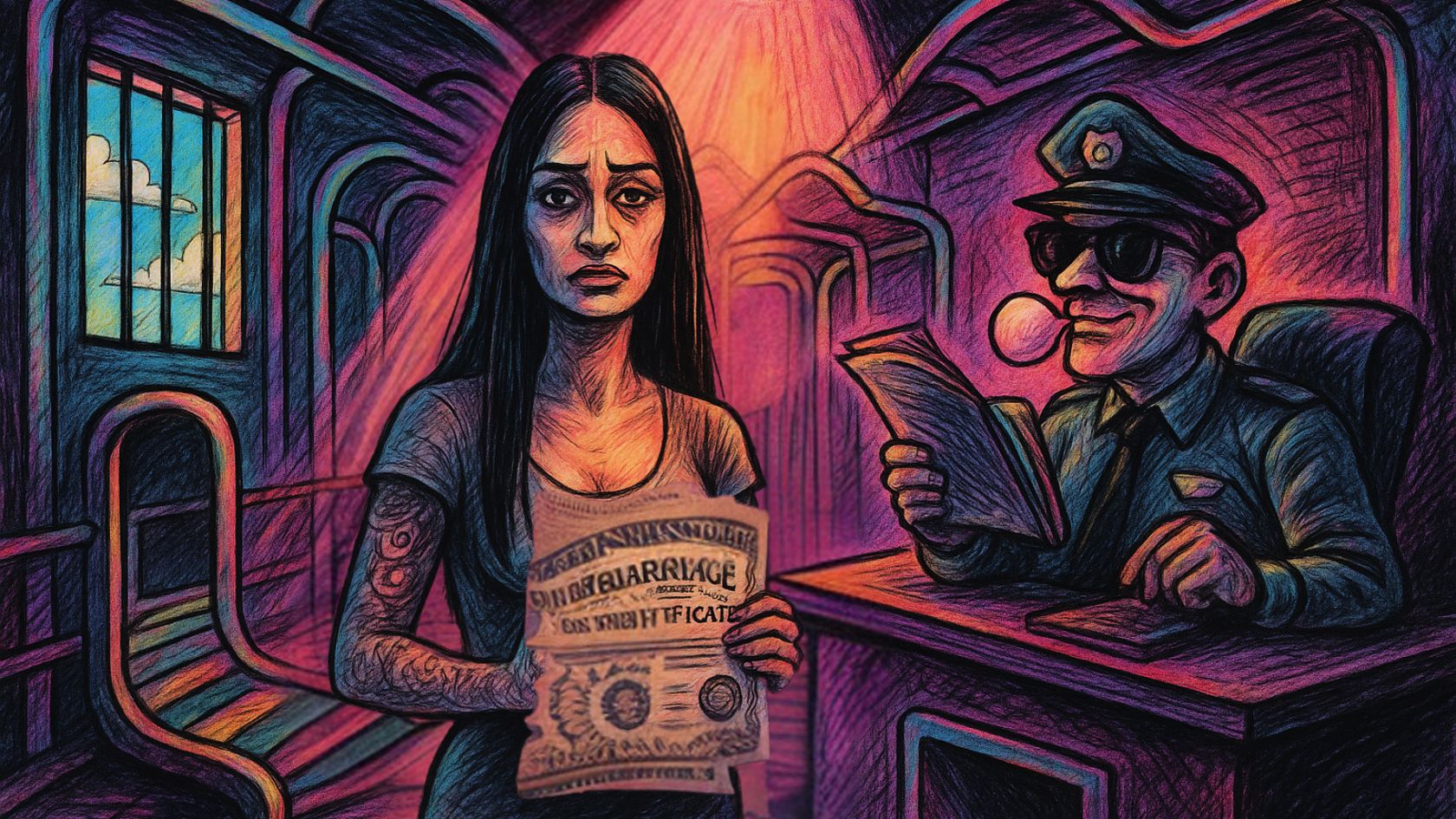
On May 18, 2025, Nicolle Saroukos, a 25-year-old former NSW police officer, landed in Hawaii to visit her U.S. Army husband. She brought her marriage certificate, her mother, and a suitcase. What she didn’t bring—what no traveler can ever pack—is immunity from suspicion.

She was detained. Interrogated. Strip searched. DNA-swabbed. Mocked. Jailed overnight with convicted criminals. Denied contact with her husband. Deported in handcuffs the next morning.

Her crime? “Too many clothes in her suitcase.” That was the stated justification.

Let’s call it what it was: a systemic flex. A declaration that due process ends at the border and your relationship to power—nationality, race, status—determines how you’re handled. That ESTA visa waiver you relied on? It’s not a right. It’s a trapdoor, opened at the discretion of someone trained to see a threat first and a human never.

Saroukos wasn’t a criminal. She wasn’t undocumented. She wasn’t trying to stay. She was a military wife visiting her husband, a man this country deemed honorable enough to wear its uniform. But when policy is driven by optics and paranoia, not facts or fairness, citizenship means nothing and marriage means even less.

This didn’t happen in a vacuum. It happened under an administration that has weaponized “national security” into a catch-all excuse for cruelty. The Department of Homeland Security is running lean on oversight and bloated with enforcement muscle. ICE and CBP are emboldened, not accountable. And when foreign nationals—even those from allied nations—are treated like smugglers based on vibe checks and tattoo rumors, what we’re seeing isn’t immigration policy. It’s power theater.

Saroukos’ case isn’t isolated. It echoes the chilling of rights across the board—journalists detained, academics canceling trips, and refugees shut out by design. She became visible because she spoke out. Most don’t. Most can’t.

And still, the silence from Washington is deafening. No apology. No clarification. No accountability.

What happened to Nicolle Saroukos was not a mistake. It was policy, functioning exactly as it was intended: to intimidate, to control, to remind the rest of us that the Constitution doesn’t cross borders—and in some rooms, neither does basic decency.

She said she’d never return to the U.S. I wouldn’t either.

But I’ll say this to her: You were right to speak. Loud, clear, and unflinching. Because these systems thrive on silence—and your refusal to be quiet made you dangerous in the best possible way.


Is this the “again?”

You ever wonder what part of “great” they’re talking about?

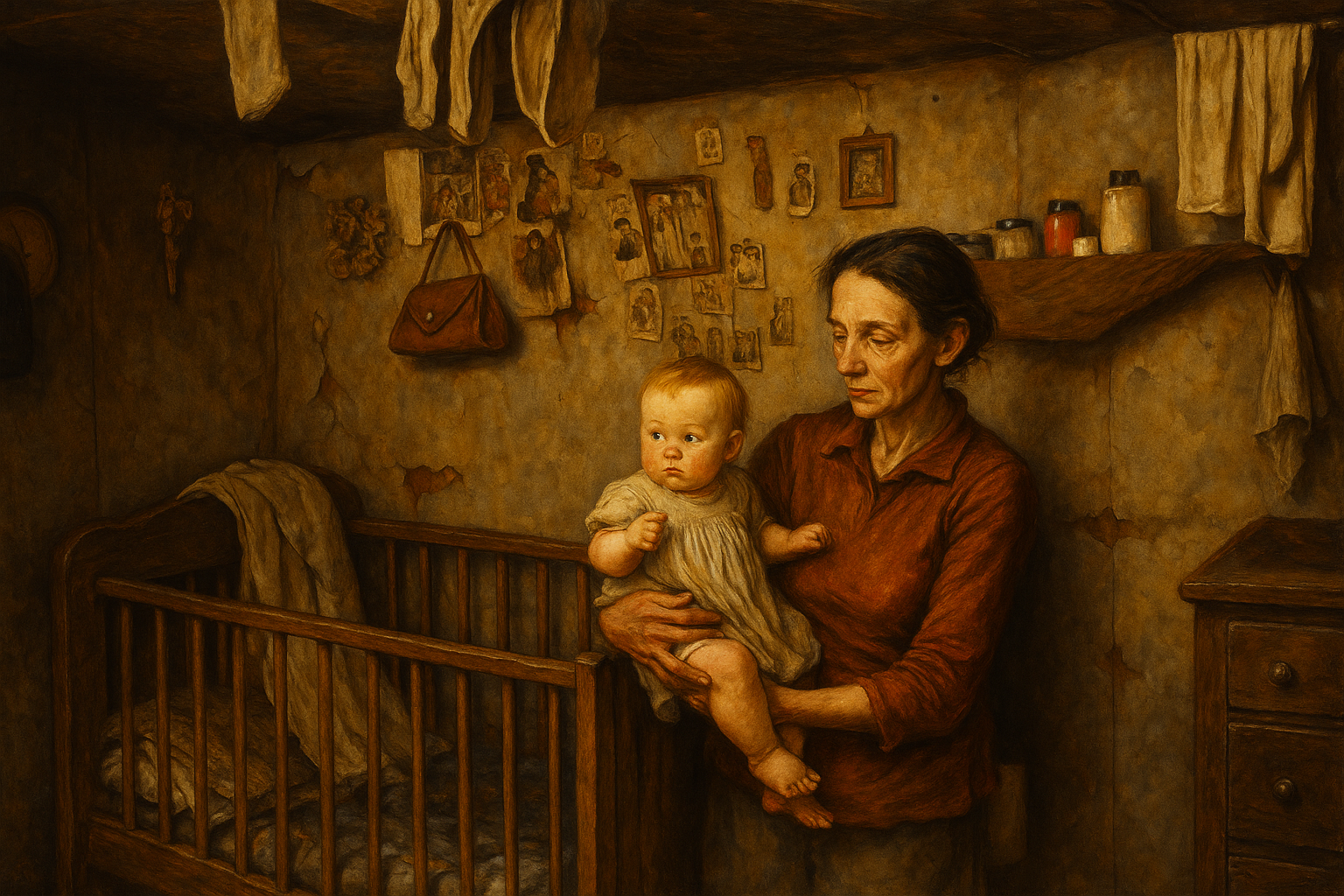
I look at this image—this mother, worn thin as yesterday’s dishwater, holding a child with nothing but the next hour on her mind—and I think: this is the lie, dressed up in sepia tones and nostalgia.

Make America Great Again?

Was it great when families like this had to choose between heating the room or feeding the baby? When the pantry was empty but the church told you to be grateful? When a woman like her worked her fingers to the bone and still got called a burden?

This isn’t a memory. It’s a warning.

Because what MAGA keeps selling isn’t greatness—it’s a return ticket to desperation, sanctified by sentiment. They want us to believe this was the peak, that simplicity and suffering somehow meant virtue. But look closer. That’s not a proud America. That’s survival dressed up in Norman Rockwell’s lighting.

If this is the “again,” then no thanks. I’ve seen what comes with it: union-busting, racial segregation, domestic silence, and the grinding weight of poverty passed down like an heirloom.

We didn’t crawl out of that just to be dragged back by a slogan and a hat.

So let’s call it what it is. This “again” isn’t about greatness. It’s about control. It’s about rewriting misery as morality and telling us to be grateful for it.

I say we remember—but not to romanticize. We remember so we don’t go back.

Because this isn’t greatness.
This is the warning label.


The Past, Reimagined Like Rockwell #7

Papers, Please: When Citizenship No Longer Protects You

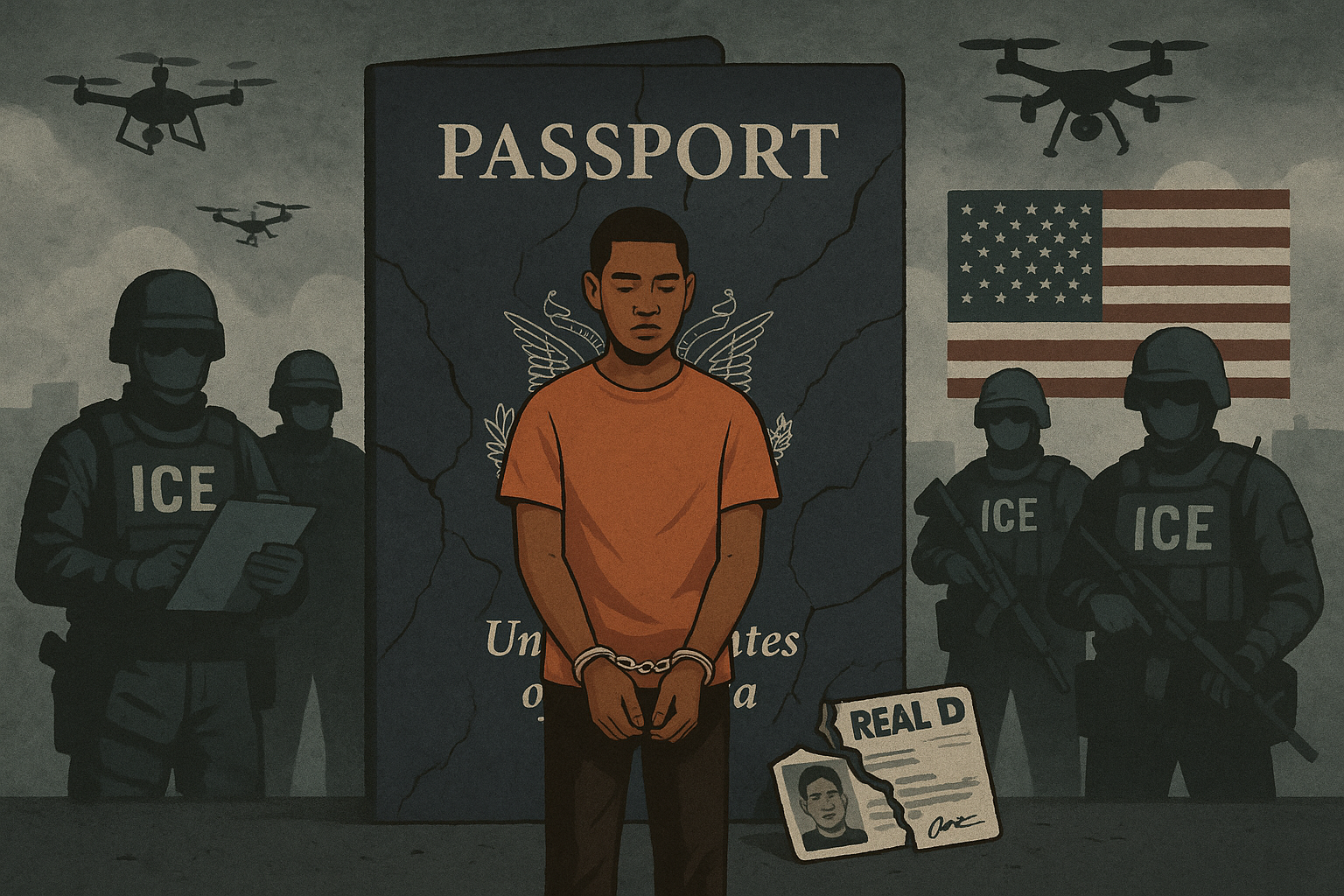
A young Latino man with brown skin and short-cropped hair stands alone, handcuffed, in front of a large, cracked U.S. passport. ICE agents with blurred, faceless helmets loom in the background, holding clipboards and rifles. The man’s Real ID lies torn at his feet. Behind him, an American flag hangs upside down. The sky is gray and oppressive, with surveillance drones circling above. The overall tone is bleak, institutional, and accusatory—highlighting injustice and racial profiling.In May 2025, Leonardo Garcia Venegas—born in Florida, carrying a Real ID, fluent in English—was tackled, handcuffed, and detained by ICE agents in Alabama. His “crime”? Being brown in a room full of white ICE uniforms.

This wasn’t a mistake. It was a system working as designed.

Garcia Venegas wasn’t the first in 2025, and he won’t be the last. Since January, there have been at least five documented cases of U.S. citizens detained under suspicion of being “unauthorized aliens”—each time due to a mix of racial profiling, dismissive treatment of valid documents, and a legal structure that offers little to no recourse when civil rights are violated by federal enforcement.

This is what authoritarianism looks like in America.

ICE’s treatment of Garcia Venegas mirrors that of:

  • Juan Carlos Lopez-Gomez, a Georgian born citizen arrested under Florida’s SB 4-C and detained despite showing a birth certificate.
  • Jose Hermosillo, held ten days after being coerced into signing documents he couldn’t read.
  • A Puerto Rican family in Milwaukee detained for the crime of speaking Spanish.
  • Jensy Machado, handcuffed on his way to work, later told it was a “misunderstanding.”

In each case, the burden was on the citizen to prove their right to exist in their own country. And in each case, ICE failed upward—no agents disciplined, no officials held accountable, no meaningful public apology issued.

This is the cost of normalizing suspicion over evidence.

Trump’s second term has made one thing violently clear: civil rights are now conditional—on skin tone, language, ZIP code. Policies and state laws like Florida’s SB 4-C effectively allow any local cop or federal agent to turn due process into a guessing game. The standard for suspicion? Ethnicity. Accent. Where your grandparents were born.

Real ID compliance? Doesn’t matter.

Birth certificate? Ignored.

Social Security number? Accepted only after trauma.

The legal rot goes deeper.

The courts are complicit. In the name of “enforcement efficiency,” federal courts have shown deference to immigration authorities, even in blatant cases of wrongful detention. Qualified immunity remains a nearly unbreachable wall, shielding ICE from the consequences of violating citizens’ rights.

Congressional oversight? Performative at best. The same House committee that spent months screaming about the “border crisis” hasn’t held a single hearing on the wrongful detention of U.S. citizens this year.

This is not incompetence. It is intent.

Wrongful detention isn’t a bug in the system—it’s the point. It sows fear. It enforces submission. It tells entire communities: “Your citizenship is provisional. We decide when it counts.”

This kind of state behavior has historical precedent. Ask any Japanese-American family about the internment camps. Ask Black Americans about stop-and-frisk. Ask Muslim Americans about post-9/11 surveillance. This isn’t new—it’s just being digitized, automated, and armed.

So where is the outrage?

Too many Americans are willing to believe that a brown man detained by ICE probably did something. That a Puerto Rican family speaking Spanish in public must have invited suspicion. That these are unfortunate but understandable “errors” in a time of “crisis.”

That’s how rights erode. Not with mass revocations, but with silent exceptions. One “mistake” at a time, until the exceptions define the rule.

And if you think your skin color, passport, or polite accent will always protect you, history says otherwise. Once the machinery of suspicion is built, it will come for more than the people you don’t know.

Final thought:

There is no such thing as a minor civil rights violation when done by the state. Every wrongful detention is a test run. Every silence a signal. Every unpunished agent a message: you can do it again.

And they will.

Because right now, the state is betting you’ll accept it.


Doug Burgum: The Technocrat Who Sold Out the Land

Doug Burgum, now serving as the 55th U.S. Secretary of the Interior under President Trump, epitomizes the transformation from tech entrepreneur to political figurehead. His journey from mortgaging his family’s farmland to fund Great Plains Software, which he later sold to Microsoft for $1.1 billion, to governing North Dakota and now overseeing vast federal lands, is marked by a consistent prioritization of business interests over environmental stewardship.

From Tech Visionary to Political Operative

Burgum’s ascent in the tech world showcased his business acumen. However, his political career, beginning with his tenure as North Dakota’s governor from 2016 to 2024, reveals a pattern of aligning with powerful interests. His gubernatorial terms were characterized by aggressive support for fossil fuel industries, including backing the Dakota Access Pipeline and promoting carbon capture initiatives that primarily served oil and gas sectors.

Interior Secretary: A Role Reimagined

As Interior Secretary, Burgum’s policies reflect a continuation of his pro-industry stance. He has advocated for increased drilling on public lands and has been instrumental in rolling back environmental regulations. His support for consolidating federal wildland firefighting efforts into a single agency under the Interior Department has drawn criticism from former officials and environmentalists, who warn of potential chaos and increased wildfire risks.

Environmental Concerns and Public Lands

Burgum’s tenure has been marked by significant budget cuts to environmental programs and national parks. His dismissal of the urgency of the climate crisis, stating there is “plenty of time” to address it, underscores a troubling disregard for scientific consensus and environmental protection. Critics argue that his policies favor short-term economic gains for the fossil fuel industry at the expense of long-term environmental sustainability.

Conclusion

Doug Burgum’s trajectory from a tech entrepreneur to a key figure in the Trump administration illustrates a consistent pattern of prioritizing business interests, particularly those of the fossil fuel industry, over environmental concerns. His actions as Interior Secretary raise critical questions about the future of America’s public lands and the nation’s commitment to addressing climate change.


Me, Myself, and My Demons

There’s a special kind of vanity that blisters the soul — the kind that doesn’t just look in the mirror, but demands the mirror lie back. What you see here isn’t a caricature. It’s an exorcism by realism. A man not haunted by demons, but composed of them. Horns? Sure. But look closer — they’re not accessories. They’re growths, earned and nurtured like a twisted bonsai of grievance, insecurity, and petulance.

Behind the waxy frown lies a furnace of me, me, me, crackling hot with the flames of entitlement. The background isn’t hell — it’s his comfort zone. “Inner Demons” isn’t a metaphor. It’s his cabinet. “Insecurity”? That’s just the press secretary. “Petulance”? Chief of Staff.

This isn’t political satire. This is a family portrait — if your family was a horror show of self-importance, surrounded by the smoldering wreckage of consequence. Some see strength in his scowl. I see a child who never stopped screaming at the world for not bending enough.

The real devil’s trick? Convincing millions he’s the victim.

Welcome to the infernal echo chamber of the MAGA American id.


Stable Genius Live!

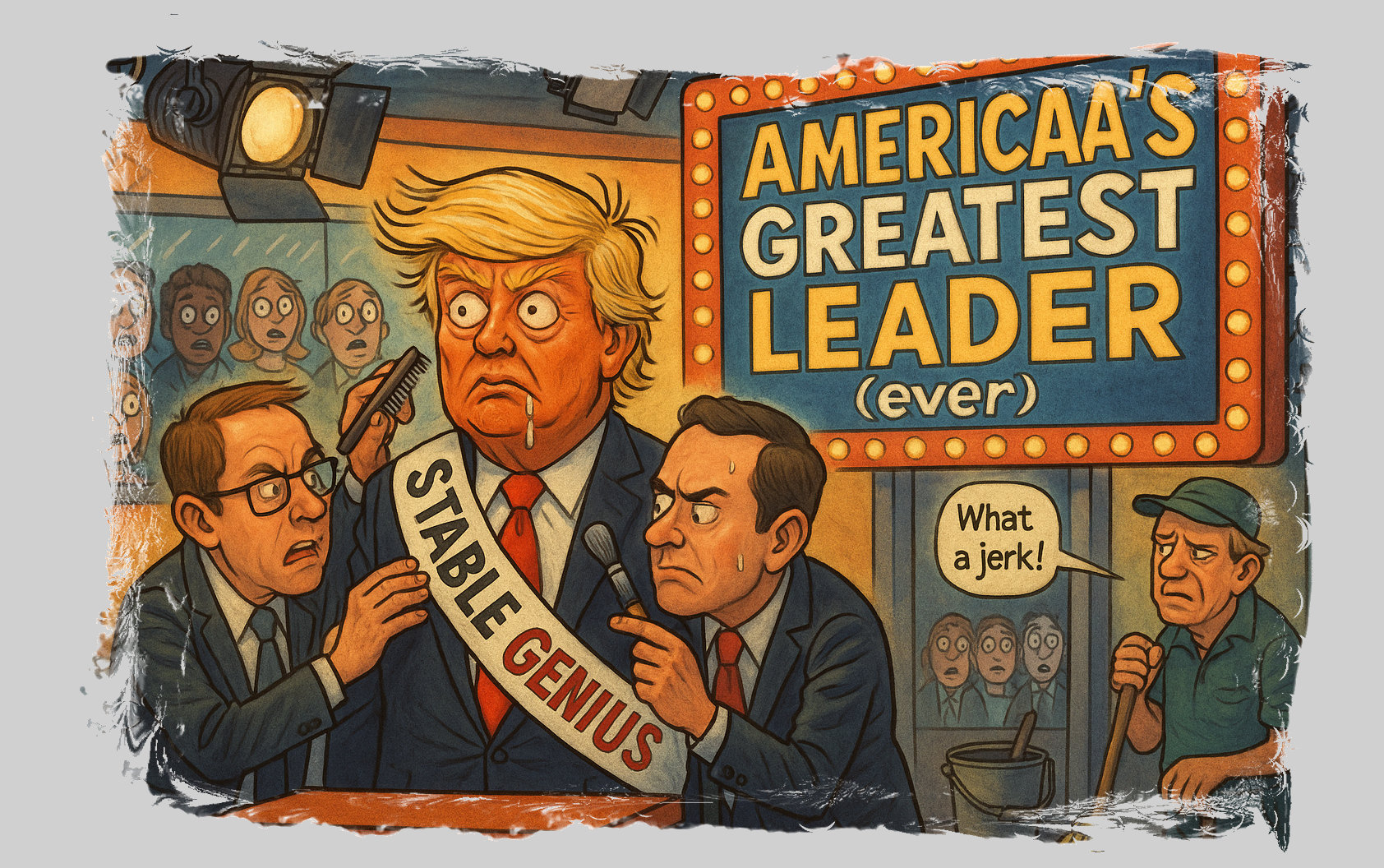
Ah yes — this one’s what I call a televised breakdown in three acts. The subject? An ego so inflated it needs handlers just to stay upright. The drool? That’s not a mistake — it’s the only honest fluid in the whole scene. The sash, of course, is sarcasm stitched in satin. You’ll notice the title’s missing an ‘I’ in ‘AMERICAA’ — intentional. Thought I’d capture the national identity crisis right in the signage.

The crowd? Glass-eyed, stunned, separated by a literal pane. That’s America watching itself in the mirror, unsure whether to laugh, cry, or buy merch. And the janitor in the corner? He’s the only sane voice left in the studio — but he doesn’t have a mic, just a mop.

It’s not a game show. It’s the aftershow of democracy.


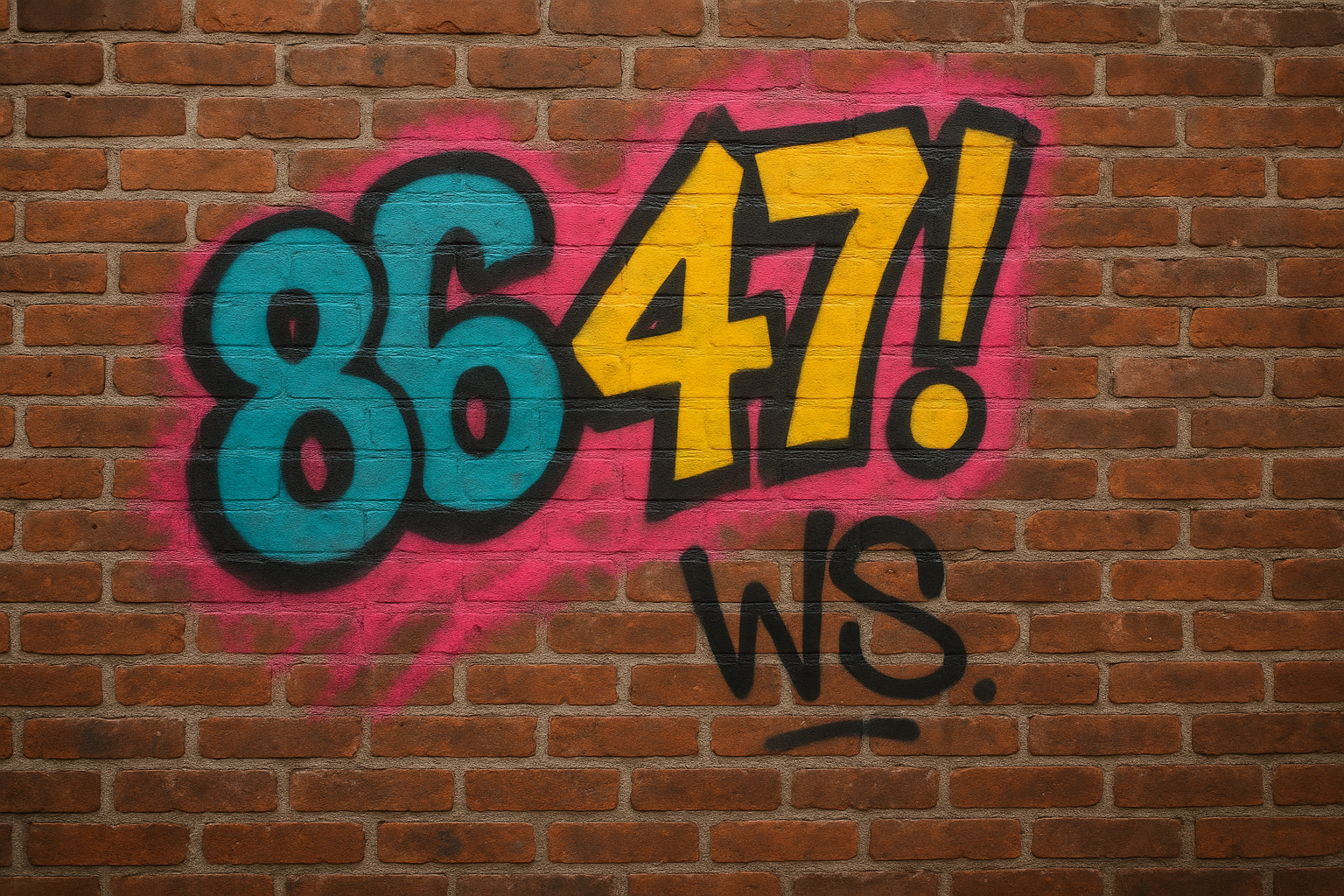
8647

“They gave him the crown again. So we gave him a number.
8647 — not a threat. A prophecy.

— W.S.

You almost have to admire the audacity.

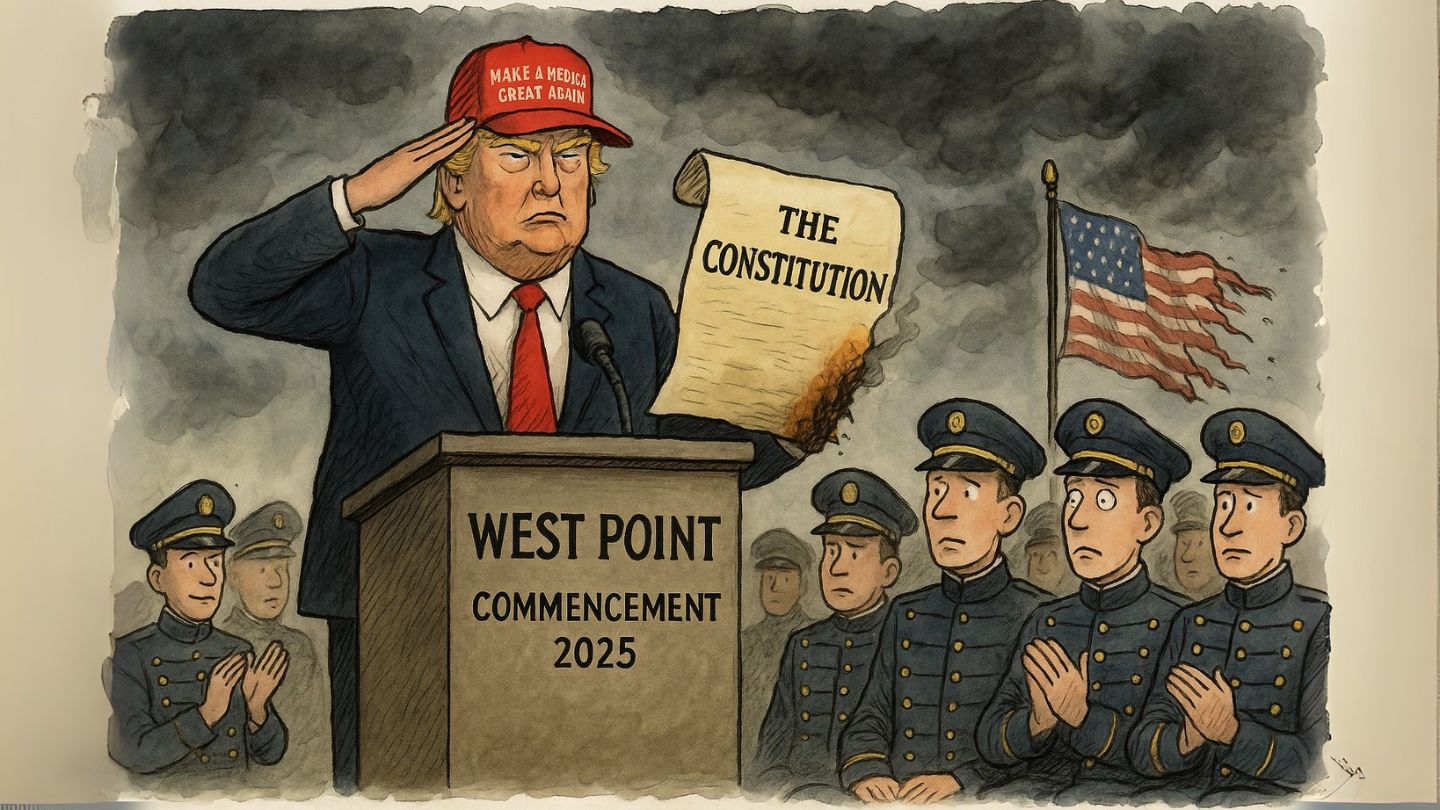
There he was—Donald J. Trump, twice-impeached, thrice-indicted, and now inexplicably back behind the Resolute Desk—giving a commencement speech at West Point. Drenched in self-praise, thinly veiled campaign propaganda, and enough anti-DEI jabs to make Tucker Carlson blush, the man used a military graduation to wage his latest cultural holy war.

He told the cadets they were the “bravest of the brave.” Fine. They’ve earned that. But what followed wasn’t a salute—it was a strategy session.

Instead of focusing on unity, discipline, or the burden of military leadership, Trump steered the speech straight into grievance territory. He railed against “woke ideology,” claimed the military had been weakened by “social experiments,” and then, with a smug grin, declared that under his leadership, the armed forces would return to “real strength.” Translation: purge the ranks of anyone who doesn’t fit his idea of what an American soldier should look like—or think like.

Let’s not kid ourselves. This wasn’t a commencement address. It was a declaration of war against dissent, diversity, and the very notion of civilian oversight of the military. This is a man who’s still fuming that generals wouldn’t deploy tanks in American streets during the George Floyd protests. A man who still fantasizes about loyalty oaths and mass firings. And now, he’s back in power, preaching militarized nationalism with a grin and a teleprompter.

The tragedy is that those cadets—sharp, committed, and idealistic—deserved better. They deserved a speech that honored service, not one that peddled suspicion and authoritarianism.

But Trump doesn’t do honor. He does domination.

And if we’re not careful, he’ll turn West Point into a campaign rally and the Constitution into a napkin. Again.