Men Working Together

Men Working Together
Based on a 1941 OWI photograph by Alfred T. Palmer, reimagined in the style of Norman Rockwell.

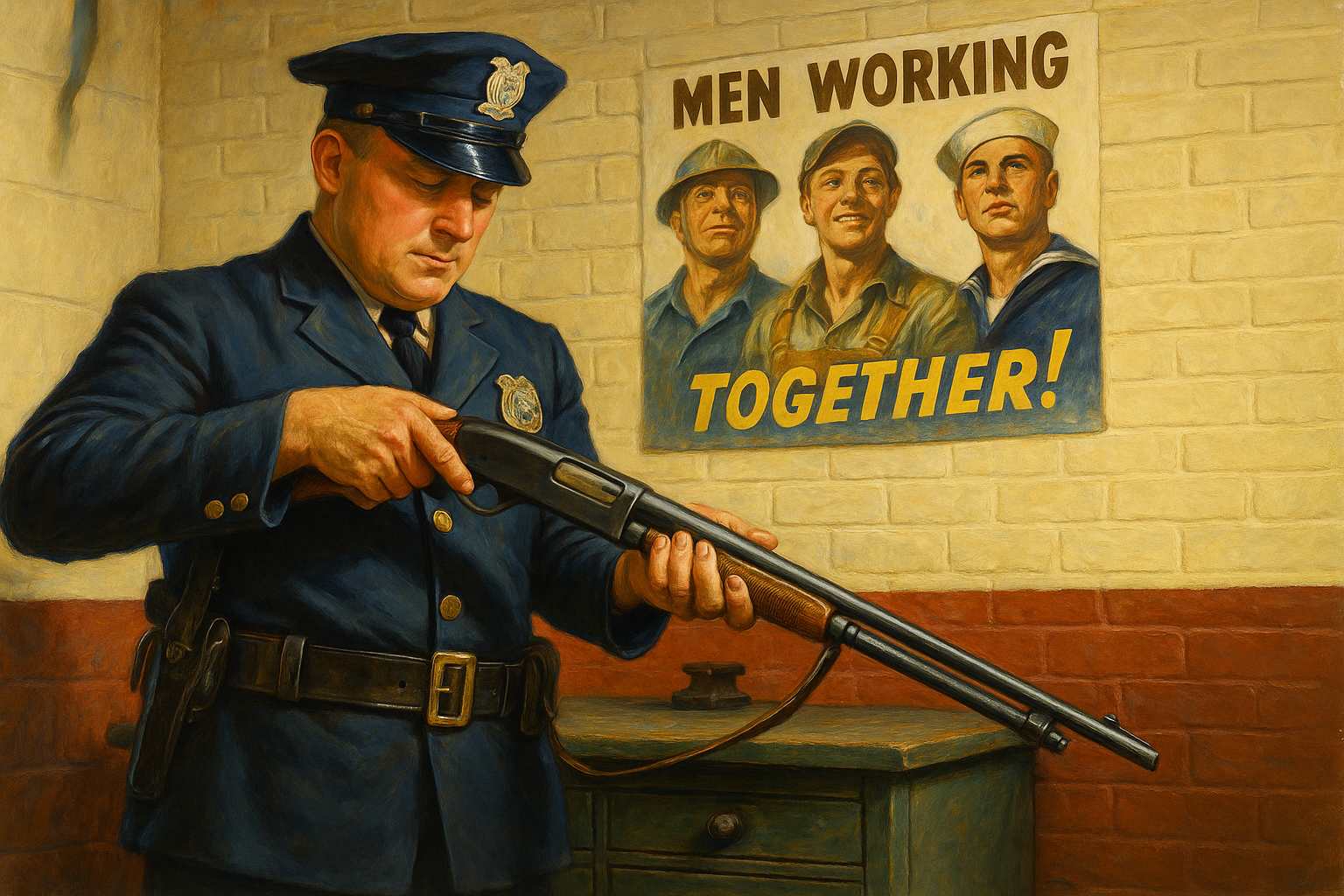
In this image, a uniformed police officer inspects a shotgun beneath a wartime propaganda poster that reads: “Men Working Together!” The poster behind him shows a trio of determined faces: a factory worker, a soldier, and a sailor — unified in spirit and effort, reminders of a nation mobilized for total war.

The officer himself is calm and methodical, absorbed in the task at hand. He isn’t posing. He isn’t posturing. He’s preparing. The weapon is not brandished; it is checked. The badge on his chest glints against dark blue wool. His belt holds a club, a flashlight, and the burden of responsibility.

“So that men may work together, this sentinel keeps vigil at a large defense plant against saboteurs.” That was the original caption. The plant was the White Motor Company in Cleveland, Ohio — a major producer of trucks and machinery for the war effort. In the eyes of the government and the press, men like this officer weren’t just security — they were part of the national defense.

This reinterpretation leans into the visual language of Rockwell: rich shadows, soft skin tones, expressive hands, brick and brass and all the iconography of working-class pride. But beneath the warmth lies the tension of the 1940s. The war wasn’t just over there. It was here, too — in locker rooms, on loading docks, and behind locked doors in dim-lit precinct stations.

What’s striking about this moment — now captured in color and oil-textured form — is the quiet assertion that civilian duty and military duty were part of the same national effort. While the men in the poster stared out boldly into the imagined future, the man in front of it was holding the line at home.

“Men Working Together.” The phrase lands differently now. It’s no longer just about victory abroad — it’s about the work required to hold a society together when the world tilts hard and fast. It’s about shared responsibility, unglamorous and essential.

This is The Past, Reimagined Like Rockwell #3.


Original Source Information

  • Photographer: Alfred T. Palmer
  • Creation Date: December 1941
  • Original Caption: “So that men may work together, this sentinel keeps vigil at a large defense plant against saboteurs. White Motor Company, Cleveland, Ohio.”
  • Affiliated Agency: United States. Office for Emergency Management
  • Medium: 1 nitrate negative, 4 x 5 inches
  • Library of Congress Reproduction Number: LC-DIG-fsa-8e10709
  • Call Number: LC-USE6- D-003238 [P&P] LOT 2039
  • Repository: Library of Congress Prints and Photographs Division, Washington, D.C. 20540 USA
  • More about the collection: FSA/OWI Collection Information
A Child Whose Home Is an Alley Dwelling near the Capitol

The Past, Reimagined Like Rockwell #1


The Boy, the Board, and the Nation That Forgot Him

“You can see the Capitol dome from his alley. But it cannot see him.”

Location: Washington, D.C.
Date: Circa 1943
Original Photograph by: Esther Bubley, FSA/OWI Collection
Rendered Interpretation: 5:3 Painterly Realism

A Still Frame of Survival

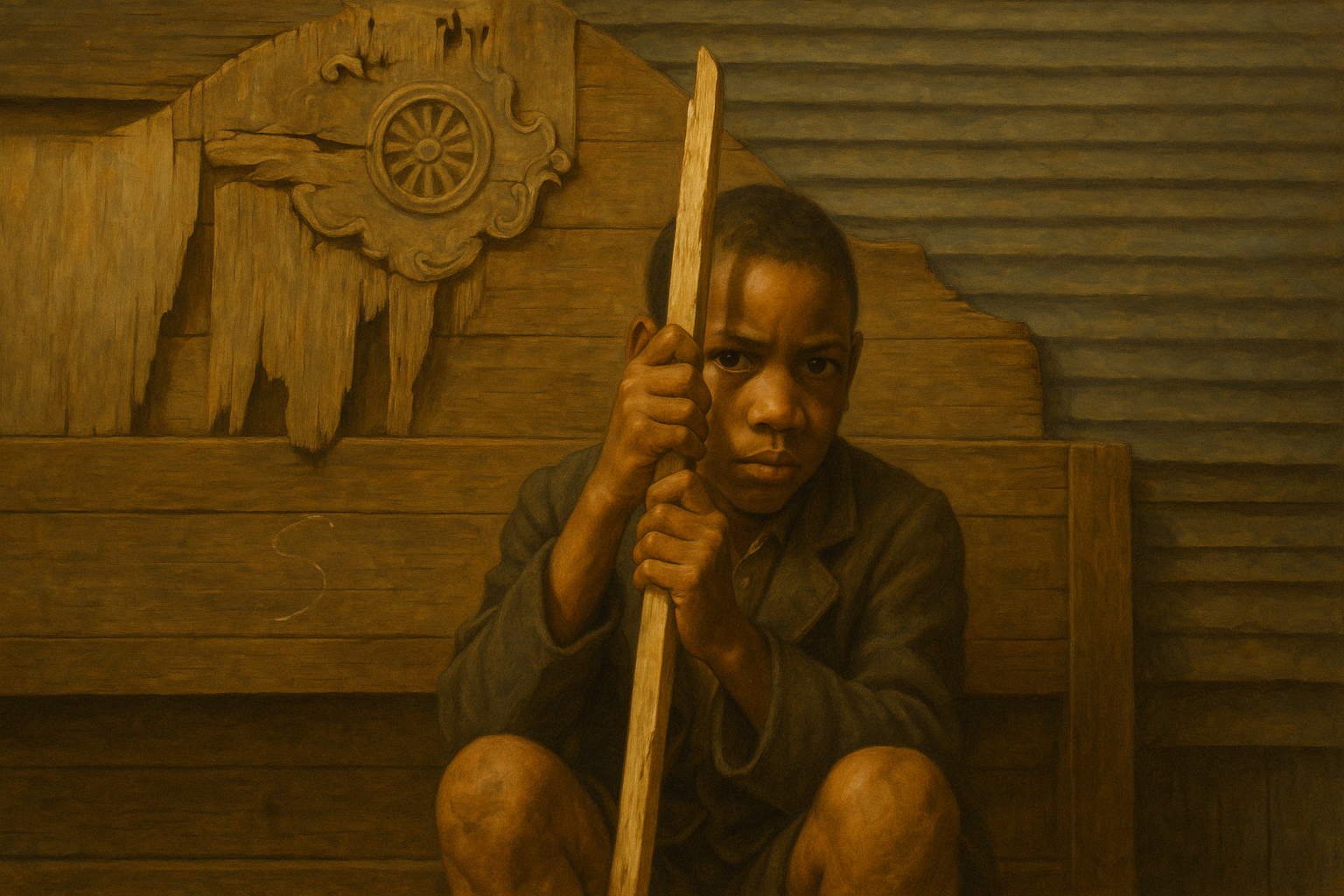
In this striking reinterpretation of Esther Bubley’s original wartime photograph, we encounter a young boy seated in the shadows of a forgotten America. Bare knees, thin jacket, and eyes that do not ask but demand acknowledgment. He holds a splintered board vertically in front of him — part defense, part shield, part toy. Behind him, corrugated metal and the decaying remains of a carved wooden ornament speak to the fragility of his surroundings.

This is not a portrait of comfort. It is a portrait of dignity, stripped and guarded.

The Boy from the Alley

Esther Bubley, one of the few female photographers working for the U.S. government in the 1940s, took this photo as part of a series on wartime life in Washington, D.C. While the city was flush with defense contracts and the Capitol building loomed in grandeur, just blocks away were alley dwellings — unplumbed, unsanitary, unsafe.

This child lived in one.

His expression is complex. Not sorrowful. Not angry. More like watchful. He doesn’t trust the camera. Maybe he’s seen what comes after a promise is made and broken. Maybe he’s heard speeches from the Capitol about liberty and justice — and watched the rats run behind his stove the same night.

Forgotten Corners of the Capital

The alley homes of D.C. were not accidents — they were symptoms. The product of racism, classism, and economic expedience. Black families and poor whites were pushed into invisible quadrants of the city, out of sight of tourists and officials.

By the time Bubley photographed this boy, reformers had already begun documenting the squalor. But the wheels of bureaucracy turned slowly. Too slowly for the thousands who would come of age in these alley shanties — breathing mold, dodging violence, learning hunger as routine.

The Reimagined Image

The rendered version of Bubley’s photo captures what the lens could not:

  • Soft lighting and warm tones bring a bruised nobility to the boy’s skin and clothing.
  • The broken headboard behind him becomes a visual metaphor for the American Dream: once ornate, now split down the middle.
  • His hands grip the board with strength and precision, not as a child playing, but as someone ready.

The image is wider now — the 5:3 composition creates breathing room. It shows the wreckage behind him and the space in front of him — as if daring us to step in, to interrupt this silence with action.

The Proximity of Power

The original title says it all:
A Child Whose Home Is an Alley Dwelling near the Capitol

Not far from monuments. Not far from lawmakers. But as far from help as anyone in America could be.

Then and Now

In 1943, this boy sat in a collapsing alley shack in the capital of the most powerful country on Earth.
In 2025, tens of thousands of children still live in similar conditions across the U.S. — in tent cities, public housing with black mold, crumbling trailer parks, and overcrowded apartments.

We still speak of justice.
We still build the Capitol higher.
And children still sit, guard, and wait.

Final Reflection

He is seated. He is small. He is still.

But don’t mistake stillness for peace.
This boy — in all his guarded silence — is asking you one question:

“Can you see me now?”

“She Held Them All”

Migrant Mother, 1936

“She is 32. She has seven children. She has nothing. She holds them anyway.”

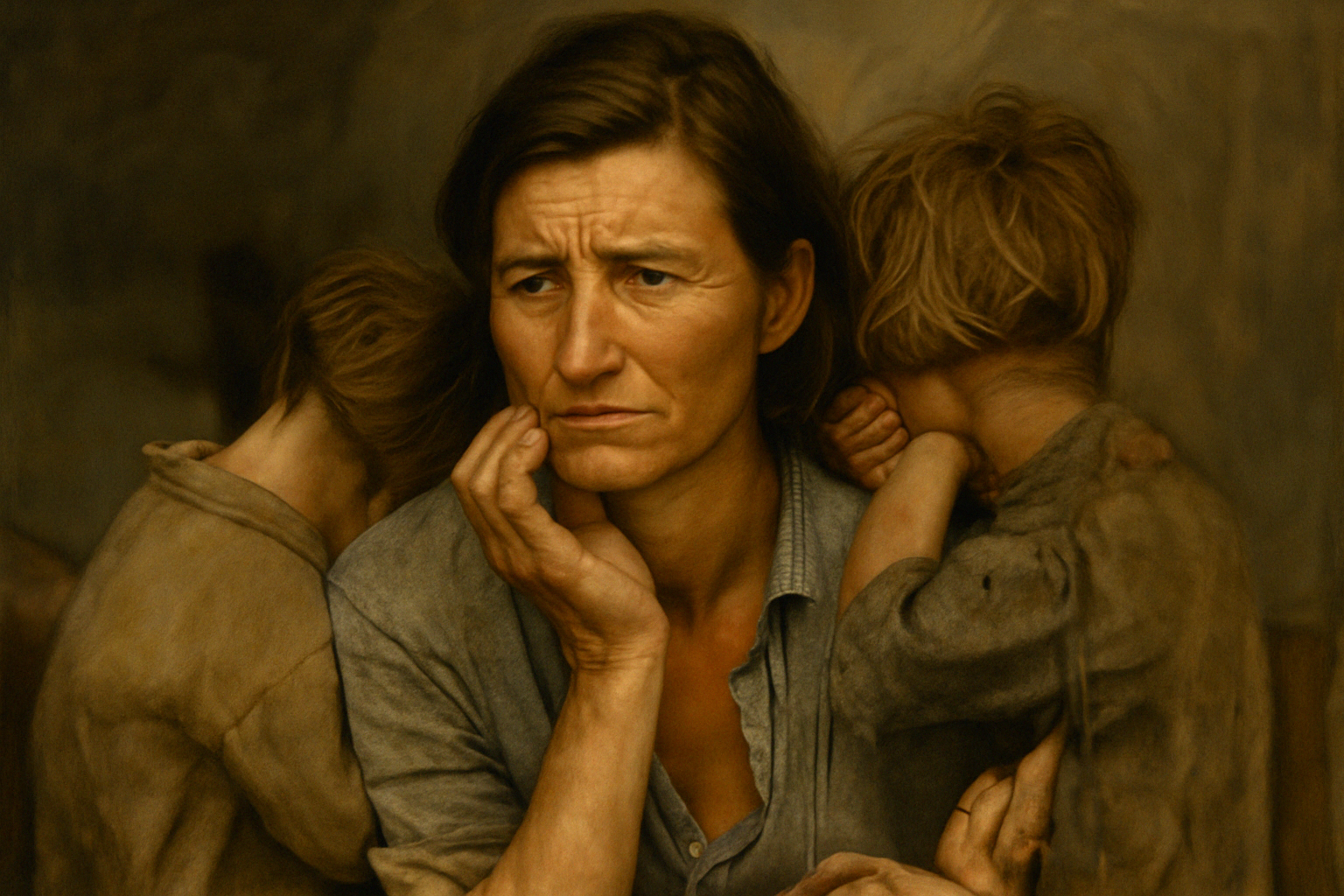
This image is a rendered reinterpretation of one of the most iconic photographs ever taken in the United States: Dorothea Lange’s Migrant Mother, captured in March 1936 during the depths of the Great Depression. The original black-and-white photo was made near Nipomo, California, in a pea-picker camp where thousands of workers had been stranded — jobless, hungry, and desperate after a crop failure. The woman pictured, Florence Owens Thompson, was a 32-year-old mother of seven, clinging to survival as the system failed around her.

She is now among the most recognizable faces in American history — but she was never paid. And she was never rescued.

A Country in Collapse

The Great Depression had reached its lowest point in early 1936. Banks had failed, jobs had vanished, farms had dried up. Hundreds of thousands of Americans — including many families — became migrants, drifting from place to place in search of food and seasonal work.

Dorothea Lange was working for the Resettlement Administration (later the FSA), documenting the conditions of America’s poor. When she encountered Florence and her children, Lange snapped six photographs. The final frame became the one we know today — a mother, hand to chin, flanked by two children whose faces are turned away, leaning into her.

She did not pose. She simply endured.

Rendering a Memory

The image above brings Lange’s original into the painter’s world: a reimagining in soft earth tones, worn textures, and realism. Her face is furrowed, not aged but weathered. The hand to her cheek — a gesture of calculation, or fear, or resolve — remains as vital now as it was then.

The children — turned away, clinging — speak to both shame and trust. They do not look at the camera. They trust that she, and she alone, can keep them safe.

The background has been softened and darkened. There is no tent, no field, no sky. Only this moment. Her moment. Centered, finally, as the figure she always was: the American mother most in need of her country — and least served by it.

Her Name Was Florence

Her name was Florence Owens Thompson. She lived for nearly fifty more years after the photo was taken — working factory jobs, picking cotton, raising ten children in poverty. She received no compensation from the image that made her face famous. She later said she regretted letting the photographer take the picture, feeling exposed and used.

It wasn’t until she lay dying in the 1980s, facing mounting hospital bills, that the public responded. A fundraising effort — built on recognition of her face alone — helped pay for her care and her funeral. In the end, Americans paid to help the “Migrant Mother” not because their government did, but because of a photo they never forgot.

Behind the Frame

The image helped justify New Deal policies, inspired support for migrant aid programs, and cemented Lange’s legacy. But Florence continued to live in hardship. She had done what was asked of her — survived, worked, sacrificed, endured — and still went unnoticed in the ways that mattered.

Her story reminds us that it is possible to become an icon while still being invisible.

The Story Continues

Nearly ninety years later, American mothers still carry the weight of a nation that promises much and delivers little. Migrant camps still exist. Child hunger still exists. Women still face impossible choices between shelter, food, and dignity.

And yet — they hold on. They hold their children. They hold the line.

Final Thought

This isn’t a relic. It’s a reflection.

“She held them all.”

The Past, Reimagined Like Rockwell #2