 Imagine this:
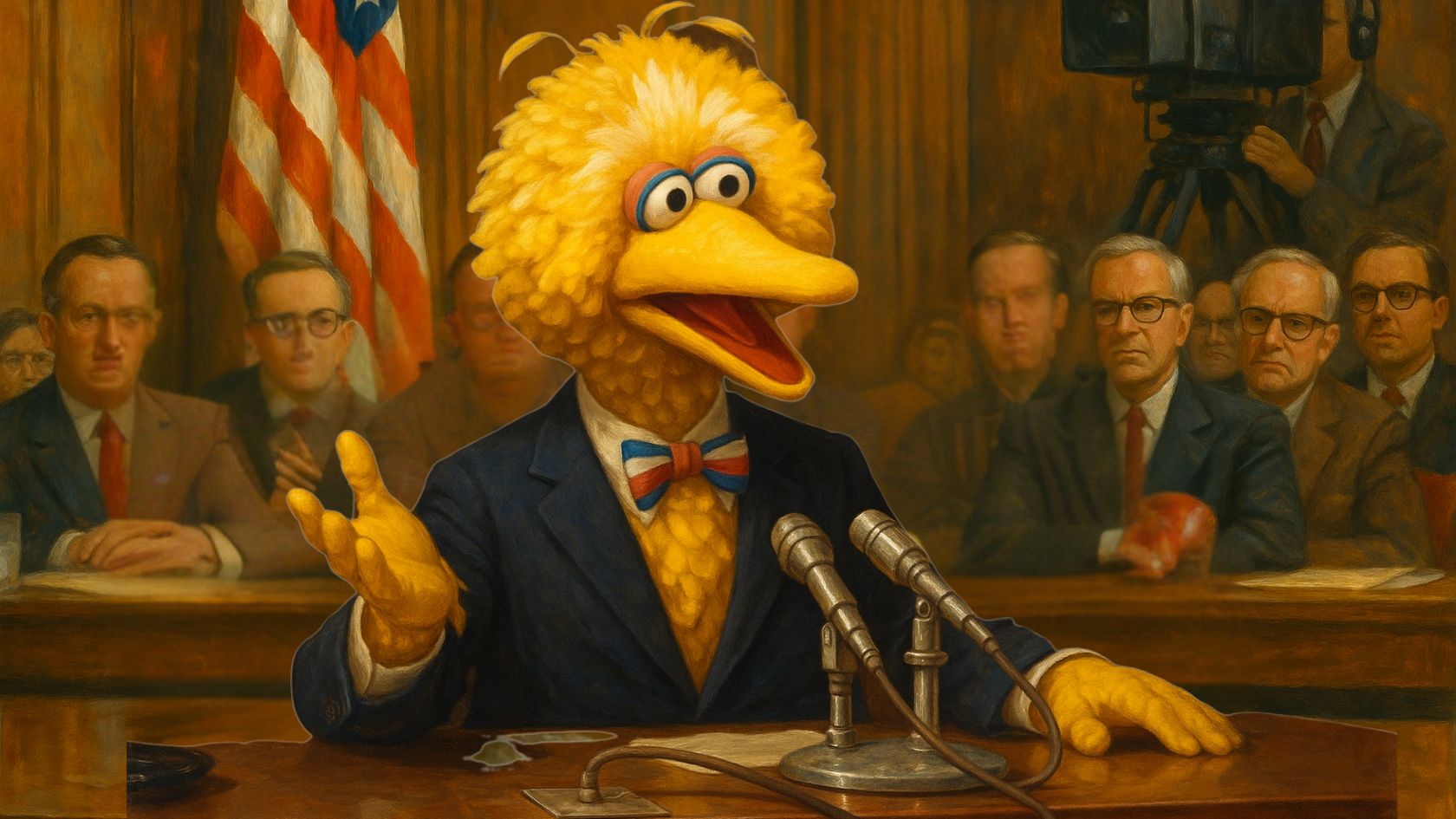
The room smells like old wood and procedural rot. Flags drape the corners like stage props. And at the witness table, with cameras rolling and necks craning, sits Big Bird. Not a parody. Not a meme. Just an eight-foot icon of everything we once thought public service meant. Yellow feathers. Bow tie. Hands too big for a gavel but steady on the microphone.
The room is quiet.
And then Big Bird speaks.
“I’m here,” he says, “because somebody has to tell you what it meant when the lights came on in houses that couldn’t afford preschool, when a child’s first words in English came from a puppet, when the only gentle adult voice in a screaming household came through a rabbit-eared TV tuned to Channel 5.”
What if Big Bird could say that?
What if he could testify?
What if he could remind us that PBS was never just about letters and numbers but about dignity—the kind that doesn’t come with a price tag or a subscription model?
The Quiet Revolution That Was Public Media
Many grew up in a trailer park where the nearest library was a 45-minute walk, and the only consistent adult presence on weekdays was their mom’s exhaustion and the television set. Big Bird was a constant. So was Mr. Rogers. So were nature documentaries narrated in warm, slow tones that taught you how to look at the world, not just consume it.
Public broadcasting wasn’t some charity case. It was infrastructure. It was a scaffolding around crumbling institutions that had already failed so many of us. PBS, NPR, and their local cousins did something radical: they presumed the public was worth investing in.
Defund the Public, Defund the Truth
But today, the knives are out.
Congressional panels with names like “The Fiscal Integrity Committee” or “The Oversight Subcommittee on Wasteful Spending” are performing the ritual sacrifice again. Same script, different year. Only now, it’s got teeth. And the targets aren’t just line items—they’re values. They’re memory. They’re the very idea that some knowledge should belong to all of us, not just those who can afford it.
Public television didn’t just teach children. It resisted the market’s gravity. It made room for programming that didn’t chase ad revenue, that didn’t traffic in outrage, that didn’t disappear the moment ratings dipped.
Kill that, and you kill the last scraps of commons we have.
What Would Big Bird Say Now?
Maybe he’d point one feathered wing toward the lawmakers and ask, plainly: “What are you afraid of?”
Are they afraid of children learning to question?
Of citizens forming their own opinions without a chyron telling them what to think?
Of communities that remember what it felt like to be served without being sold to?
Or maybe he’d just sit there quietly, watching the cameras roll, as the old men with flag pins talk about “hard choices” while signing off billions for surveillance and silence.
This Isn’t Just Nostalgia
This is a warning.
Public broadcasting was never apolitical—it was anti-apathy. And that’s what makes it dangerous to those who rely on ignorance, distraction, and tribal fear to hold power.
PBS taught generations how to listen, how to read, how to empathize. It taught us that learning could be soft, persistent, slow, and kind.
That is not the world they’re trying to build now.
Big Bird Can’t Testify—But We Can
And we should.
We should remind them that public goods are not “entitlements” but investments. That a society that can afford perpetual war can damn well afford a puppet and a piano and a softly spoken “I like you just the way you are.”
Because when the archives are locked behind paywalls, when the signal goes dark, when the last public square becomes another privatized data farm—we’ll look back and remember that the canary in the coal mine wore feathers and knew the alphabet by heart.
Big Bird doesn’t need a subpoena.
He needs us to show up.
— For the children who learned to read between eviction notices and reruns.
(and all the other kids, of whatever “class”, who learned because of what was there.)