Research by Grok
Introduction
The claim that “the Republicans don’t trust the voters” suggests that the Republican Party may lack confidence in securing electoral victories through broad, unrestricted voter participation. This could manifest in strategies that influence who can vote or how votes are counted, such as voter suppression tactics and gerrymandering. This investigative report examines the validity of this claim by analyzing evidence of voter suppression, gerrymandering, and statements from Republican leaders. By presenting detailed findings from primary and reputable secondary sources, the report aims to assess whether these actions reflect a distrust in the electorate and explore the implications for American democracy.
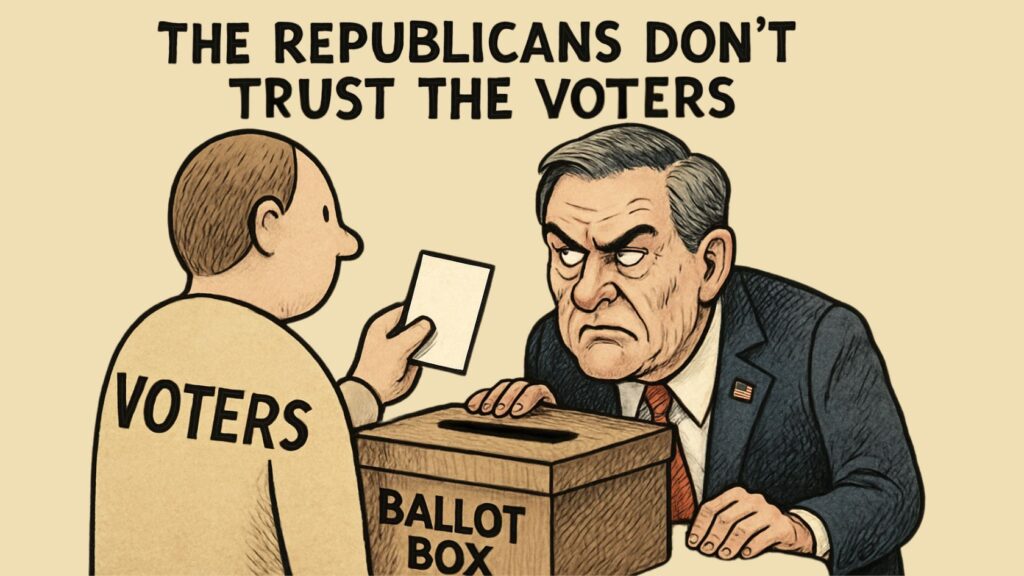 Voter Suppression Tactics
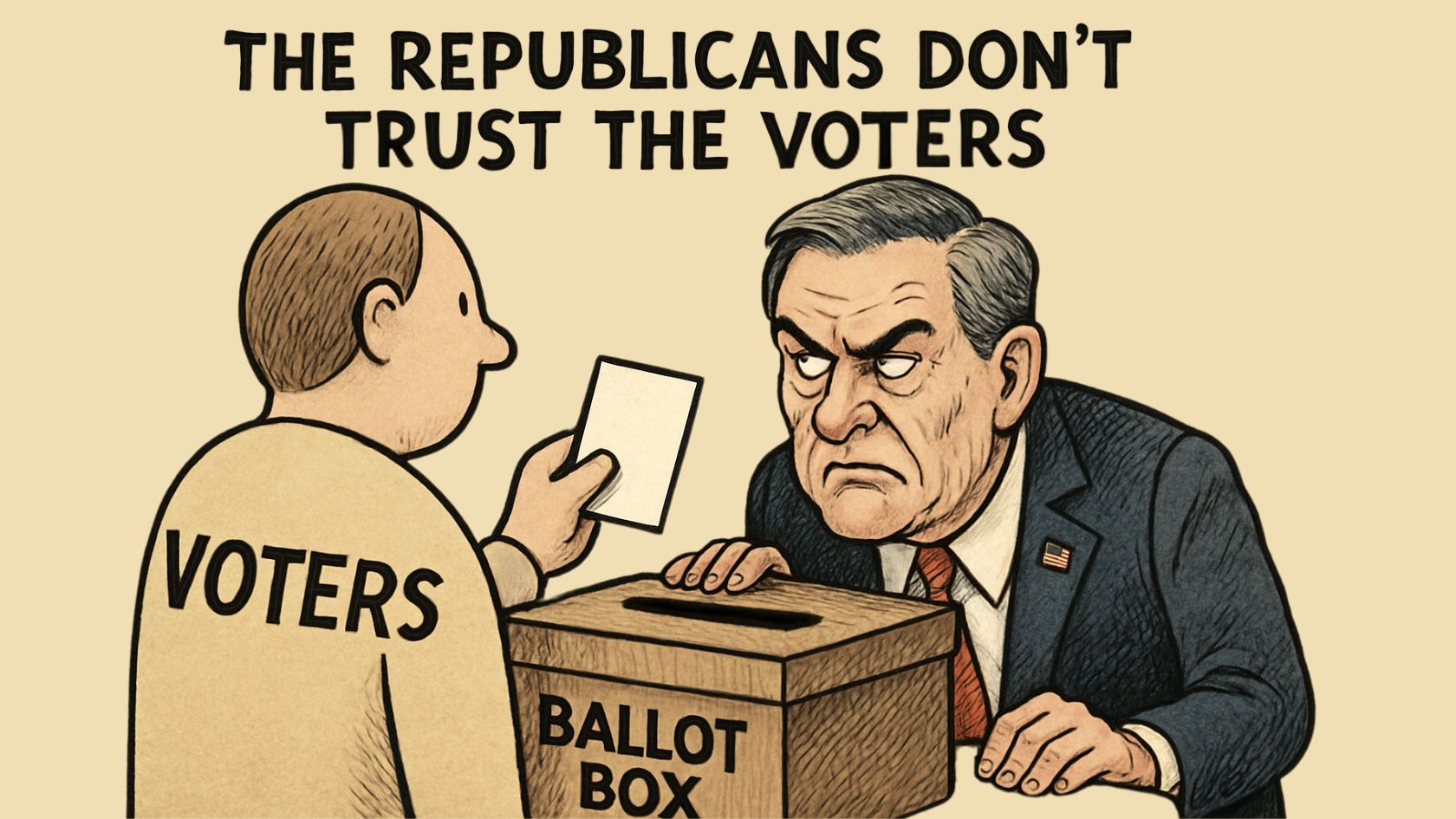
Types of Voter Suppression Tactics
Voter suppression refers to measures that intentionally or unintentionally make it harder for eligible citizens to vote. In recent years, Republican-controlled state legislatures have implemented several such tactics, including:
- Strict Voter ID Laws: These require voters to present specific forms of identification, such as a driver’s license or state-issued ID, which some eligible voters, particularly minorities and low-income individuals, may not possess. As of 2024, 36 states have voter ID laws, with 15 imposing stricter requirements since 2020 (NCSL).
- Purging Voter Rolls: This involves removing voters from registration lists, often for reasons like inactivity or address changes. In Texas, over 1 million voters were purged since 2021, including 463,000 on the “suspense list” for unverified addresses (Texas Governor).
- Reducing Polling Places: Closing or consolidating polling locations can lead to longer wait times and travel distances, discouraging turnout. In Georgia, counties with larger minority populations have fewer polling sites per voter (ACLU).
- Limiting Early Voting and Mail-in Voting: Restrictions on early voting hours or mail-in ballot access reduce voting flexibility. Georgia’s 2021 law limited drop boxes to early voting sites and shortened mail ballot request periods (New York Times).
- Criminalizing Voter Assistance: Laws that penalize helping voters, such as providing water to those in line, have been enacted. Georgia’s Senate Bill 202 bans such “line-warming” activities (Washington Post).
These tactics are often framed as efforts to enhance election security, but their impact on voter access raises questions about their intent.
Impact on Voter Turnout
Research consistently shows that restrictive voting laws disproportionately affect minority, low-income, and young voters, who are more likely to vote Democratic. A 2017 study found that strict voter ID laws reduce turnout by 2-3 percentage points, with Latino turnout dropping by 10.3% and multi-racial turnout by 12.8% in states with photo ID requirements (IPPSR). In Texas, voters without proper IDs, who are disproportionately Black and Latino, face barriers despite court-ordered remedies (Brennan Center).
In Georgia, the 2021 voting law led to an 81% drop in mail voting from 2020 to 2022, with Black voters, who accounted for 30% of mail ballots in 2020, facing greater hurdles (New York Times). Despite record turnout in the 2022 primaries, the racial turnout gap between white and Black voters was the largest in a decade, suggesting suppression effects (Brennan Center). High turnout does not negate suppression, as competitive races and mobilization efforts can offset barriers.
In Texas, Senate Bill 1 (2021) imposed restrictions on mail voting and criminalized voter assistance, leading to challenges for voters with disabilities and minorities (Brennan Center). Voter roll purges have also raised concerns, with activists arguing that eligible voters are erroneously removed (U.S. News).
Justification vs. Evidence
Republican leaders justify these measures as necessary to prevent voter fraud and restore trust in elections. For instance, Georgia’s Secretary of State Brad Raffensperger claimed the 2021 law balanced access and security, citing record turnout (Georgia SOS). Texas Governor Greg Abbott stated that removing over 1 million ineligible voters protects democracy (Texas Governor).
However, evidence of voter fraud is scarce. A Brennan Center report found impersonation fraud rates between 0.0003% and 0.0025%, with only 31 credible instances out of 1 billion ballots from 2000 to 2014 (Brennan Center). In Texas, a review of 84 million votes found just 14 fraud cases (Brennan Center). Courts, including those with Republican-appointed judges, have consistently dismissed claims of widespread fraud (Brennan Center).
Some Republicans have admitted partisan motives. Former President Donald Trump stated in 2020 that Democratic voting reforms would mean “you’d never have a Republican elected in this country again” (The Guardian). In Wisconsin, a Republican lawmaker introduced restrictive bills to address “sincere concerns” about elections, despite no evidence of fraud (Wikipedia). These admissions suggest that voter suppression may be a strategic effort to limit Democratic-leaning voters rather than a response to fraud.
| State | Types of Restrictions |
|---|---|
| Georgia | Limits on mail voting, drop boxes, voter ID, bans on line-warming (New York Times) |
| Texas | Strict voter ID, mail voting restrictions, voter roll purges, criminalizing assistance (Brennan Center) |
| Florida | Drop box limits, voter registration restrictions, ballot collection bans (Democracy Docket) |
| Arizona | Voter ID, mail ballot restrictions, voter roll purges (FiveThirtyEight) |
| Iowa | Shortened early voting, mail ballot restrictions (Brennan Center) |
Gerrymandering
Explanation and History
Gerrymandering involves redrawing electoral district boundaries to favor one political party, often by “cracking” (spreading opponents’ voters across districts) or “packing” (concentrating them into fewer districts). Named after a 1812 Massachusetts district resembling a salamander, gerrymandering has been a feature of U.S. politics for centuries (Wikipedia). Modern technology allows precise manipulation, amplifying its impact.
Republican Use and Impact
Since 2010, Republicans have leveraged control of state legislatures to draw favorable maps through the REDMAP (Redistricting Majority Project) initiative. By winning key state races in 2010, Republicans controlled redistricting in 213 congressional districts, creating some of the most extreme gerrymanders in history (Brennan Center). In Pennsylvania, Republicans held 13 of 18 congressional seats in 2012 despite Democrats winning the statewide vote (WBUR).
Nationally, gerrymandering gives Republicans an edge in the House. A 2024 Brennan Center analysis found 23 extra GOP-leaning seats in Republican-drawn maps, compared to 7 Democratic-leaning seats in Democratic maps (Brennan Center). This skew distorts representation, allowing Republicans to maintain power disproportionate to voter preferences.
Case Study: North Carolina
North Carolina exemplifies Republican gerrymandering. After the 2020 census, a court-drawn map resulted in a balanced 7-7 Democratic-Republican split in 2022, reflecting the state’s competitive electorate. However, in 2023, a Republican-majority state Supreme Court overturned anti-gerrymandering precedents, allowing a new map that could yield 10 Republican and 3 Democratic seats, with one competitive district (New York Times). This shift, despite North Carolina’s close statewide races, illustrates how gerrymandering can entrench power.
The 2019 Supreme Court ruling in Rucho v. Common Cause declared partisan gerrymandering non-justiciable in federal courts, leaving states to regulate it (Wikipedia). This has enabled aggressive gerrymandering in states like North Carolina, where Republican control of the legislature and judiciary facilitates biased maps.
| State | Party in Control | Skewed Seats |
|---|---|---|
| North Carolina | Republican | Up to 4 additional Republican seats (New York Times) |
| Pennsylvania | Republican (pre-2018) | 13 of 18 seats despite Democratic vote majority (WBUR) |
| Florida | Republican | 20 of 28 seats in 2022, despite 51% Republican vote share (Brennan Center) |
Statements and Rhetoric
Quotes from Republican Leaders
Republican leaders have made statements suggesting that unrestricted voting could harm their electoral prospects, supporting the claim of distrust in voters. Key examples include:
- Donald Trump (2020): During a Fox & Friends appearance, Trump opposed Democratic voting reforms, stating, “They had things, levels of voting that if you’d ever agreed to it, you’d never have a Republican elected in this country again” (The Guardian).
- RNC Court Filing (2025): The Republican National Committee intervened to defend an anti-voting executive order, arguing that “more accessible voting hurts Republican candidates” (Democracy Docket).
- Wisconsin Lawmaker (2021): A Republican legislator introduced restrictive bills, citing “sincere concerns about our electoral system,” despite no evidence of fraud (Wikipedia).
- Montana Representative (2021): A Republican openly stated that ending Election Day registration was necessary because young voters, who use it, “are not on our side of the aisle” (Brennan Center).
Analysis
The rhetoric from Republican leaders indicates a strategic approach to elections that prioritizes limiting access for certain voter groups over competing on policy merits. Trump’s admission that expanded voting would end Republican victories directly supports the claim that the party distrusts an unrestricted electorate. The RNC’s 2025 court argument further confirms this, framing accessibility as a partisan liability.
This rhetoric contrasts with the evidence of minimal voter fraud, suggesting that “election integrity” claims may serve as a pretext for partisan advantage. By focusing on restricting access rather than broadening appeal, Republicans appear to doubt their ability to win in a fully participatory democracy, aligning with the claim under investigation.
Counterarguments and Context
Republican Perspective
Republicans argue that restrictive voting measures are necessary to ensure election integrity and prevent fraud, particularly after the 2020 election, which saw unprecedented mail-in voting due to the COVID-19 pandemic. Leaders like Raffensperger and Abbott emphasize that their laws balance access with security, pointing to high turnout as evidence of fairness (Georgia SOS, Texas Governor). They claim that voter ID laws and roll purges target ineligible voters, such as non-residents or deceased individuals, to maintain accurate voter lists.
On gerrymandering, Republicans contend that redistricting is a political process, and their maps comply with legal requirements. They argue that Democrats also gerrymander in states like Illinois and New York, and the Supreme Court’s Rucho decision affirms state control over redistricting (Wikipedia). They maintain that their actions are within the bounds of democratic norms.
Democratic Strategies
Democrats are not immune to electoral manipulation. In states they control, such as Illinois and Maryland, Democrats have drawn maps that favor their party, though the scale is smaller than Republican efforts (Brennan Center). Democrats also advocate for expanded voting access, such as automatic voter registration, which critics argue could benefit their voter base. This suggests that both parties engage in strategic electoral tactics, though the report focuses on Republican actions due to the claim’s specificity.
Historical Context
Voter suppression and gerrymandering are not new phenomena. Historical examples include literacy tests and poll taxes used to disenfranchise Black voters in the Jim Crow era, and both parties have gerrymandered when in power (Wikipedia). The Voting Rights Act of 1965 addressed many overt suppression tactics, but its 2013 weakening in Shelby County v. Holder allowed states to implement new restrictions without federal oversight (Brennan Center). This historical backdrop contextualizes current Republican efforts as part of a longer tradition of electoral manipulation, though modern tactics are more sophisticated.
Implications for Democracy
The evidence of voter suppression and gerrymandering by Republicans has significant implications for American democracy. By making voting harder for certain groups, particularly minorities, these measures undermine the principle of equal access to the ballot. Gerrymandering distorts representation, allowing a party to maintain power despite losing the popular vote, as seen in Pennsylvania’s 2012 elections (WBUR). These actions can erode public trust in elections, as voters perceive their voices are not fairly heard.
The disproportionate impact on minority voters raises concerns about racial equity. Studies show that Black and Latino voters face greater barriers under restrictive laws, perpetuating systemic disparities (Brennan Center). This could violate the spirit, if not the letter, of civil rights protections.
Moreover, the rhetoric from Republican leaders, such as Trump’s 2020 statement, fuels perceptions of distrust in the electorate (The Guardian). When leaders openly suggest that broader participation threatens their party, it undermines democratic norms and encourages further restrictive measures.
Conclusion
The evidence strongly supports the claim that “the Republicans don’t trust the voters.” Through voter suppression tactics, such as strict voter ID laws and mail voting restrictions, Republicans have made voting harder, particularly for minority and Democratic-leaning groups. Gerrymandering, exemplified by cases like North Carolina, allows Republicans to secure disproportionate representation. Statements from leaders like Trump and the RNC reveal a belief that unrestricted voting threatens their electoral success.
These actions have significant implications for American democracy, as they undermine the principle of equal representation and access to the ballot. While Republicans argue these measures ensure election integrity, the rarity of voter fraud and the disproportionate impact on certain voters suggest a strategic effort to shape the electorate. Democrats also engage in electoral strategies, but the scale and impact of Republican-led restrictions since 2020 are notable.
Protecting voting rights and ensuring fair redistricting are critical to maintaining a robust democracy. Federal legislation, like the stalled Freedom to Vote Act, could address these issues, but partisan divides remain a barrier (Brennan Center). Continued scrutiny and advocacy are essential to ensure that all eligible voters can participate freely and fairly.
Key Citations
- Voter ID Laws Overview
- Texas Voter Roll Purges
- Voter Suppression Impact
- Georgia Voting Law Analysis
- Voter ID Laws and Minority Turnout
- Impact of Voter Suppression on Communities of Color
- Georgia Mail Voting Decline
- Texas Voter Suppression Law Trial
- The Myth of Voter Fraud
- Election Was Secure
- Trump on Voting Reforms
- Wisconsin Voting Restrictions
- Egregious Voter Suppression Laws
- History of Gerrymandering
- Gerrymandering Explained
- REDMAP and Gerrymandering
- 2024 House Race Gerrymandering
- North Carolina Gerrymander
- Rucho v. Common Cause
- RNC Defends Anti-Voting Order
- Florida Voter Suppression Law
- Georgia Supreme Court Ruling
- States Restricting Voting
- Voting Laws Roundup October 2021
- Racial Gap in Georgia Primary
- Shelby County v. Holder